Capturing brand loyalty through customer relationship management: exploring the roles of customer brand engagement and psychological contracts from a dual perspective
Dual features of customer brand engagement
Numerous studies have described customer brand engagement as the dynamic state of a customer when he or she interacts with a brand (Gambetti and Graffigna, 2010; Hollebeek et al. 2014; Salonen et al. 2024; So et al. 2024). From the definition of engagement itself, engagement describes a complete psychological state formed in the interactive process of a customer (J. Kumar, 2021a, 2021b). However, several studies have revealed the behavioral aspects of engagement. Stated that customer brand engagement behavior refers to “consumers’ commitment and engagement behaviors toward a brand related to specific interactions that originate from motivational factors”. On the basis of these studies, customer brand engagement encompasses psychological and behavioral aspects. That is, the psychological root reveals the spiritual attributes, whereas the behavioral root reveals the influence on various behavioral motivations (Hollebeek et al. 2022; So et al. 2024).
The dual origins of customer brand engagement are further substantiated by its multidimensional nature. Scholarly consensus supports the insight that customer brand engagement is a multidimensional concept encompassing cognition, affection, and behavior (Barari et al. 2021; Weng et al. 2022). These interior parts of customer brand engagement reflect its mental and rational features. While prior studies have begun to investigate the features of customer brand engagement, they have attracted the attention of scholars for a long time (Suraña‐Sánchez and Aramendia‐Muneta, 2024). For example, Kumar et al. (2019) and Chen et al. (2019) identified the rational and emotional features of customer brand engagement (Chen et al. 2019; Hollebeek et al. 2022; V. Kumar et al. 2019). Moreover, Bozkurt et al. (2021) distinguished between psychological and active engagement, with customer commitment playing a mediating role (Bozkurt et al. 2021). Previous studies have demonstrated that customer brand engagement is a multidimensional concept that incorporates cognitive, affective and active brand engagement (Lim and Rasul, 2022; So et al. 2024; Weng et al. 2022). Specifically, cognitive brand engagement represents a customer’s level of thoughts and elaboration of customer–brand interaction; affective brand engagement indicates a positive degree of affection in customer–brand interaction; and active brand engagement indicates the energy, time and effort spent in customer–brand interaction (Hollebeek et al. 2014). In summary, the psychological aspect primarily delves into affection and relationships, whereas conversely, the behavioral aspect focuses more on cognition and transactions.
The revelation of these dual features of customer brand engagement makes us curious about the respective roles played by these dual features. Nevertheless, current studies have examined these two features of customer brand engagement, but they have not investigated their functions. With respect to the psychological and behavioral aspects of customer brand engagement, the research gap is obvious. Although some scholars have focused on these special features, research on them remains simple and unclear.
Psychological contract theory for explaining the dual features of customer brand engagement
To reveal the functions of customer brand engagement’s dual features, psychological contract theory has several effects on this interpretability. Psychological contract theory emerged from social exchange theory and was once used to explain the relationship between employees and employers (Kim and Kim, 2024; Roehling, 1997; Rousseau, 1989). Historically, Rousseau (1989) defined the psychological contract as “an individual’s beliefs regarding the terms and conditions of a reciprocal exchange agreement between the focal person and another party. Key issues here include the belief that a promise has been made and a consideration offered in exchange for it, binding the parties to some set of reciprocal obligations” (Rousseau, 1989). With increased research on relationship marketing, psychological contracts are beginning to attract the attention of marketing researchers. Given this definition, most marketing scholars agree that the psychological contract with customers is a reflection of the customer relationship (Daniel et al. 2022; Kim and Kim, 2024). Hence, psychological contract theory is suitable for understanding customer brand engagement because of its inherent ability to explain relationships.
Given that social exchange theory is the theoretical foundation for the customer psychological contract, the contract indicates that two parties can make reciprocal exchanges with each other. Sometimes, these exchanges evolve into transactions. Hence, it is preferable to use the psychological contract to explain the transaction aspects of the relationship from the social exchange point of view (Bi, 2019; Deepa and Baral, 2021; Ismail Juma Ismail, 2022). Accordingly, the most important aspect of the psychological contract is that it is transactional. However, the fact that the psychological contract is a relational concept cannot be neglected. Therefore, it still has both spiritual and relational aspects. According to Kingshott et al. (2021), the psychological contract has an impact on service brand evaluations from the relational and transactional points of view (Kingshott et al. 2021). Tomprou and Lee (2022) studied the psychological contract of employees using an algorithm. They argued that the psychological contract is based on socioemotional and economic exchanges (Maria and Lee, 2022). Thus, it can reveal both emotional and rational responses, which represent psychological (socioemotional) and behavioral (economic-based) aspects, respectively.
The above review on psychological contract theory posits that when customers engage with brands, they construct relationships with brands on both emotional and rational levels, encompassing both relational and transactional aspects. The two aspects of the psychological contract fulfill the requirements of customer brand engagement by aligning with it, serving as a bridge to explore in depth the role of its interior parts.
Detecting the functions of the dual features of customer brand engagement based on psychological contract theory
The relationship between customer brand engagement and psychological contracts
The above literature review shows that psychological and behavioral aspects are dual features inherent in customer brand engagement. Moreover, customer brand engagement affects its relative outcomes. This indicates that, while associated with psychological contract theory, customer brand engagement works by simultaneously stimulating these dual features. Hence, these dual features form a certain congruence when customer brand engagement works. That is, the congruence effect indicates that the duality influences the results of customer brand engagement simultaneously.
With the interpretability of psychological contract theory, customer brand engagement exerts effects on psychological contracts through the congruence of its duality. Prior studies have demonstrated that customer brand engagement facilitates the construction and maintenance of the customer–brand relationship (Weng et al. 2022). Based on the relationship foundation of psychological contracts, customer brand engagement positively influences psychological contracts. Moreover, the congruence of its duality facilitates the construction of a psychological contract.
Although its dual features positively influence psychological contracts, the interior functions of different parts of customer brand engagement actually vary. Because customer brand engagement includes cognitive, emotional, and behavioral aspects (Hollebeek et al. 2014; V. Kumar and Pansari, 2016), customers retain an interactive state with the brand and thereby have different effects on the psychological contract. To detect the different functions of the dual features of customer brand engagement, this constructive process needs to be advanced, in which the psychological and behavioral functions of customer brand engagement play various roles.
According to customer behavioral theory, cognitive engagement is the initial step of customer brand engagement, referring to the transactional foundation of exchange (Hollebeek et al. 2020; J. Kumar, 2021a). This transactional feature of cognitive engagement facilitates the construction of psychological contracts from a behavioral/economic viewpoint. Thus, the transactional psychological contract is more affected by cognitive engagement.
Considering the development process of customer brand engagement, the next step is increasing customer affection for a brand. After this stage, customer brand engagement begins to evolve more mentally and psychologically. Customers begin to overlook the material exchange relationship with the brand, desiring to engage with the brand on a spiritual level (Bozkurt et al. 2021). Affective engagement is both cognitive and affective, which means that affective engagement helps individuals form psychological and behavioral relationships with brands (J. Kumar, 2021b; Márcia et al. 2023). Thus, affective engagement more strongly influences transactional and relational psychological contracts.
Finally, when customers decide to actively engage with brands, they demonstrate that they are ready to establish a relationship with those brands. According to the current research, active engagement is the highest level of customer brand engagement (Hollebeek et al. 2019; Matute et al. 2019; Yousaf et al. 2020). Therefore, it is conducive to building and maintaining steady relationships between customers and brands since this dimension has a more socioemotional basis. Consequently, active engagement has a greater impact on the relational psychological contract.
The above analysis of the interior multiple parts of customer brand engagement reflects its dual features as well as the varied functions of these different parts. In summary, customer brand engagement facilitates the construction of a psychological contract in the congruence of its dual features; its multiple parts exert different effects on the construction of a psychological contract. On the basis of the above analysis, H1 and its subhypotheses can thus be proposed as follows:
H1. Customer brand engagement facilitates the construction of a psychological contract through the congruence of the two features of customer brand engagement.
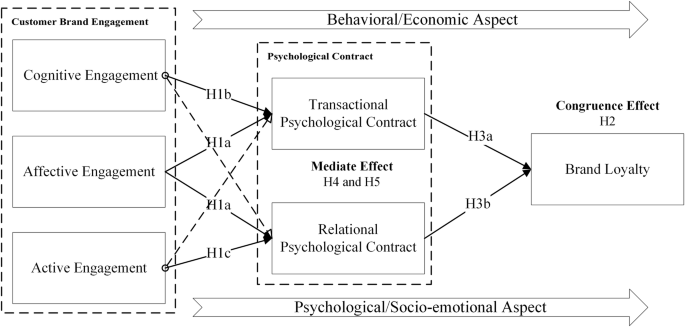
H1a. Compared with cognitive and active engagement, affective engagement more positively affects the construction of transactional and relational psychological contracts with customers.
H1b. Compared with active engagement, cognitive engagement more positively affects the construction of transactional psychological contracts.
H1c. Compared with cognitive engagement, active engagement more positively affects the construction of relational psychological contracts.
The effects of customer brand engagement and psychological contracts on brand loyalty
Brand loyalty indicates that customers support brands by their behavior, such as by repeatedly purchasing the brands or recommending the brands to others, and furthermore, reflects a certain stable relationship between customers and brands (Gounaris and Stathakopoulos, 2004; Oliver, 1999). Building upon this definition, current studies on brand loyalty reveal that customers deliver their loyalty to brands from attitudinal and behavioral aspects (Dong et al. 2011; Nam et al. 2011; Parris and Guzmán, 2023). Consequently, brand loyalty is crucial for representing a stable relationship between customers and brands, with its attitudinal and behavioral foundations.
According to the foundation of brand loyalty, it can be improved by customer brand engagement because of its dual features (Hollebeek, 2011; Kosiba et al. 2018; Ningthoujam et al. 2020; So et al. 2016b; Leckie et al. 2016). In addition, the basis of brand loyalty can also be explained using a psychological contract. Thus, the psychological and behavioral features of customer brand engagement simultaneously positively affect brand loyalty through psychological contracts. On the one hand, this viewpoint indicates that the congruence effect of the dual features of customer brand engagement on brand loyalty. Hence, we summarize that customer brand engagement facilitates brand loyalty from a particular point of view and that the dual features of customer brand engagement exert consistent effects on improving brand loyalty.
On the other hand, a number of studies have indicated that a psychological contract has a considerable effect on brand loyalty (Gillani et al. 2021; Kingshott et al. 2021). These studies suggest that customers attempt to interact with brands from both the relational and transactional perspectives. Initially, they evaluate whether the brand can meet their demands, allowing them to form a rational perception of the brand. Additionally, customers need brands to provide mental stimulation to them. Hence, according to psychological contract theory, a psychological contract would satisfy the attitudinal and behavioral foundations of brand loyalty (Kim and Kim, 2024). Thus, a transactional psychological contract helps construct customer brand loyalty at the behavioral level, and a relational psychological contract helps construct customer brand loyalty at the attitudinal level.
Based on this analysis, H2 and H3 are posed as follows to verify this effect.
H2. Customer brand engagement facilitates brand loyalty through the congruence of the dual features of customer brand engagement.
H3. The formation of customer brand loyalty is facilitated by transactional and relational psychological contracts.
The mediating effect
We have investigated the dual features of customer brand engagement and its interpretability via psychological contract theory. H2 and H3 present the results of customer brand engagement by brand loyalty. Furthermore, psychological contract theory indicates that it has the potential to explain the aligned role of customer brand engagement and brand loyalty.
With the alignment of the dual features of customer brand engagement, the foundations of brand loyalty and psychological contract theory, customer brand engagement facilitates the construction of brand loyalty through psychological contracts through the congruence effect of the dual features of customer brand engagement. Furthermore, the above analysis indicates that the duality of customer brand engagement has distinct effects on psychological contracts and brand loyalty. Specifically, the interior parts of customer brand engagement positively influence brand loyalty through psychological contracts. That is, the psychological and behavioral features of customer brand engagement have distinct effects on the construction of customer brand loyalty both attitudinally and behaviorally, in which the psychological contract mediates this process relationally and transactionally.
Initially, according to psychological contract theory, psychological contracts play an aligned role in combining customer brand engagement with the dual features and foundations of brand loyalty. Thus, psychological contracts mediate the relationship between customer brand engagement and brand loyalty. Moreover, the relational and transactional parts of the psychological contract mediate the relationship psychologically and behaviorally. Specifically, customers first base the relationship on transactional interaction, which leads to a mechanism between cognitive engagement and brand loyalty through the transactional psychological contract. Furthermore, with the development of engagement, affective engagement facilitates the formation of customer brand loyalty through both transactional and relational psychological contracts. Finally, active engagement constructs customer brand loyalty based on the relational aspects, in which the relational psychological contract has a mediating function. On the basis of this analysis, H4 with its subhypotheses can be formulated as follows:
H4. Psychological contracts mediate the construction of customer brand engagement and brand loyalty.
H4a. A transactional psychological contract mediates the relationship between cognitive and affective engagement and brand loyalty.
H4b. A relational psychological contract mediates the relationship between affective and active engagement and brand loyalty.
Based on the above analysis, we can construct the theoretical framework of this study, which is shown in Fig. 1.
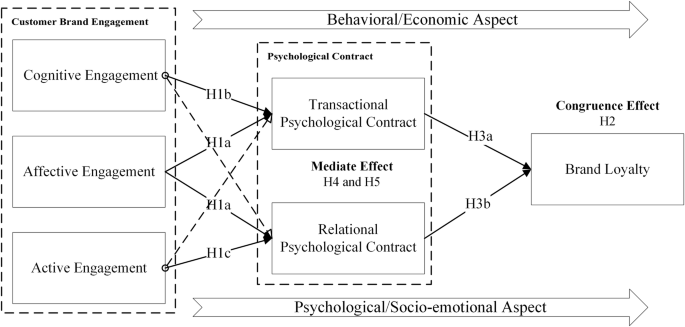
This theoretical model illustrates the driving mechanism of brand loyalty through customer brand engagement, grounded in psychological contract theory and encompassing both behavioral/economic and psychological/socio-emotional dimensions.
link