What affects peer interaction in universities? Examining the effects of paternalistic leadership and peer leadership on peer interaction of teachers | BMC Psychology

A university, as part of society, is influenced by the business environment. Therefore, university management should align with its innovative approach. This enables breaking the traditional static management model. As a result, the university can switch to a dynamic management concept that develops brand new characteristics for management.
Peer interaction (PI) facilitates knowledge sharing and skill development, especially among experienced teachers. It helps them face educational innovation and challenges, thus improves teaching quality [1]. PIs among teachers promote job satisfaction, enhance teacher effectiveness, and increase professional engagement [2]. The role of leadership in PIs shows that informal interactions among teachers can effectively stimulate and expand leadership behaviors, influencing their teaching practices and professional growth [3]. Effective leadership should be conveyed through peer collaboration, a form of interaction particularly impactful in creative fields [4].
A president is responsible for the promotion of university administration [5]. The president plays multiple roles across different eras and contexts, especially in how they shape the university’s soul and academic atmosphere based on their personal traits and the specific needs of the institution. The literature points out that a president’s personality and values can leave a lasting impression on the university’s long-term development, potentially extending beyond their tenure [6]. A president’s paternalistic leadership (PL) can create a stable and supportive environment within the academic community. In such an environment faculty feel a heightened sense of security, thus creative collaboration and PI are promoted [7]. Kerr and Gade [6] suggest that a president is the soul of academic culture, with a leadership style that subtly influences cooperation and interaction among faculty members. Therefore, he becomes more popular as the campus becomes more democratic, and his leadership becomes more important [8]. This type of leadership, especially PL helps establish harmony and a sense of belonging within the university community.
The universal presumption as the leadership research originated from management science in the West has been challenged and questioned by researchers in recent years [9]. Chinese culture is based on the long-standing doctrines of Confucianism; thus, patriarchal governance is emphasized in the country [10, 11]. PL is especially prominent in Asian countries, resonating with cultural values of respect, social harmony, and collaboration, aligning with cultural needs and widely believed to enhance teamwork [12]. PL is usually adopted by the presidents of universities as well. It can be stated that the national culture, local customs, and thinking models are completely different from those in other countries. Therefore, the full application of the Western leadership perspective might not be accepted, and may even result in non-adaptation. Another point is that the practice of this Western leadership style in Eastern society might result in ignoring significant, important, and unique characteristics of Eastern culture [13].
Previous research on leadership has focused on the analysis, introduction, and practice of Western leadership perspectives in Eastern societies; however, the effectiveness of educational leadership in Eastern universities has not been fully tested [14]. Researchers challenged the claim that Western management can work in different cultures as effectively as it works in its original context reminding the saying that “cement in the wrong place is nothing more than dirt” [15]. PL is characterized by clear and powerful authority but it shows high personal conduct by caring and understanding the subordinates [16]. PL is observable with the orders and firm decisions. Other characteristics are benevolence and care, and sacrificing self-interest to introduce various cultural stimuli to students. PL also aims to promote learning outcomes to become the moral role models for younger generations.
Many recent studies on Chinese PL aimed to explore a leadership style with local cultural characteristics. At its core, PL involves leaders who are concerned with the welfare of employees while emphasizing obedience and compliance. This style is often seen as a blend of traditional family ethics and organizational management methods. It is typically divided into three primary dimensions: authoritarianism, benevolence, and morality [17]. Within academic institutions, presidents or academic leaders who adopts PL can foster a sense of belonging and loyalty, contributing to harmony within the academic community [18].
The application of PL in higher education can positively influence PIs. Research suggests that the benevolence and moral components of PL can strengthen emotional connections among teachers, helping them feel cared for and supported, which in turn increases their willingness to collaborate [19]. PL includes the leadership behaviors that meet the expectations of Chinese culture. It is usually applied in Chinese business organizations, where participants are often general employees [20, 21]. However, research on peer leadership (PLD) behavior in the Chinese context is scarce. The exploration of PI still needs more scholarly efforts to develop [22].
At the national level, research on the influence of PL and PLD on teacher interactions has primarily focused on the following areas:
-
1.
Impact of PL on Teacher Behavior: Zhang et al. [23] examined the effects of PL on teachers’ affective commitment and organizational citizenship behaviors in higher education. The findings revealed that benevolent and moral leadership were significantly positively correlated with teachers’ affective commitment. This further promoted collaborative behaviors within teams. However, authoritarian leadership showed no significant impact on teachers’ affective commitment.
-
2.
Leadership Styles and Academic Team Collaboration: Chen and Li [24] studied academic teams in universities and found that the moral dimension of PL significantly enhanced collaboration efficiency and academic output among teachers. Conversely, authoritarian leadership was found to suppress innovation within teams. PLD was shown to be particularly important in small-to-medium-sized academic teams. It facilitates resource sharing and professional development among faculty members.
-
3.
Application and Impact of PLD in Higher Education: Wang [25] explored the effects of PLD on the professional growth of faculty in higher education. The study found that PLD strengthened trust among teachers, promoted knowledge sharing, and improved teaching innovation. PLD was particularly impactful among teachers with similar levels of experience, fostering a culture of healthy competition and collaboration.
Most existing research focuses on general university faculty or multidisciplinary teams, overlooking the unique characteristics of faculty. Therefore, it is safe to claim that a notable gap exists in the literature. Teachers often exhibit distinct teaching methods, professional development needs, and team interaction dynamics. However, previous research has rarely mentioned the role of PLD, its application, and its effects within faculty. This study provides a deeper analysis of PLD. It also examines how PLD fosters collaboration and interaction among faculty in higher education through empirical evidence. Additionally, most prior studies have examined the effects of PL or PLD in isolation. The present study emphasizes the interplay between these two leadership styles and their combined influence on teacher interactions. Therefore, it contributes to a more comprehensive theoretical framework.
This study adopts the theory of Paternalistic Leadership Theory (PLT), framing leaders as “parents” and incorporating three core traits: authority, benevolence, and morality. PL styles are particularly common in Asian cultures, where they provide cultural adaptability and significantly influence member behaviors within an organization, offering a theoretical foundation to understand the impact of PL on teacher interactions in educational settings [8]. This study integrates multiple theoretical frameworks to comprehensively explain the relationships among PL, PLD, and PI within the context of higher education, particularly among faculty. These frameworks provide a solid foundation for understanding the mechanisms by which leadership styles influence interpersonal dynamics among educators.
-
1.
PLT: PLT serves as a framework for analyzing how various dimensions of leadership—authority, benevolence, and morality—impact interpersonal trust, emotional attachment, and collaboration among faculty. These faculty members often characterized by a strong sense of autonomy and individuality, which makes this theory especially relevant.
-
2.
Social Exchange Theory (SET): By incorporating SET, this study examines how leadership styles promote positive PIs through reciprocal exchanges. For instance, the support from benevolent leaders may encourage teachers to reciprocate through collaborative behavior with colleagues.
-
3.
Leader-Member Exchange Theory (LMX): LMX theory is applied to evaluate how variations in leaders’ interactions with individual faculty members influence peer dynamics. It emphasizes the creation of an inclusive and collaborative environment that fosters stronger interpersonal connections among teachers.
-
4.
Self-Determination Theory (SDT): SDT helps explain how PLD characterized by shared decision-making and mutual support fulfills teachers’ intrinsic needs for autonomy, competence, and relatedness. This, in turn, enhances positive PIs and fosters professional growth.
-
5.
Social Identity Theory (SIT): SIT is the basis for examining how a shared identity among faculty cultivates a sense of belonging and collective purpose. This shared identity encourages cooperative behaviors and strengthens PIs.
-
6.
Organizational Climate Theory: In the context of this study, Organizational Climate Theory explains how PL and PLD styles contribute to fostering an environment conducive to collaboration and knowledge sharing among faculty.
The integration of these theories provides a multidimensional framework for understanding how leadership styles shape PIs. This approach not only bridges gaps in the existing literature but also offers valuable insights into fostering collaboration and innovation among educators.
Therefore, it is necessary to further discuss scholars’ views on PL in relation to the current situation of local schools. Leadership styles should also be consistent with local conditions, such as the context of a country and people’s mindset. PL and PLD styles in universities were discussed from the perspective of PIs among teachers. The aim of this study is to examine the impact of PL and PLD on PIs among faculty in university departments. The research hypothesizes that through a supportive environment, PL effectively promotes mutual assistance and collaboration among faculty. It enhances academic innovation and educational quality. This study fills the research gap concerning PLD behavior and the impact of PL on PI among university faculty. The contributions of this study are as follows: 1. Expanding the Application of PL Theory in Education: This study investigates the applicability of different dimensions of PL within the context of faculty, particularly its impact on PIs. In this way, it extends the theoretical understanding of paternalistic leadership in the unique environment of education. 2. Enhancing the Empirical Foundation of PLD Theory: Research focuses on how PLD fosters professional development and collaboration among teachers, offering evidence-based insights. This contribution provides practical guidance for university administrators seeking to implement effective leadership strategies. 3. Deepening Research on Management Practices in Education: By addressing the specific characteristics of faculty, this study suggests effective strategies to promote teacher collaboration and interaction. These findings serve as valuable references for managing academic teams and enhancing cooperative dynamics within education. This study is expected to help university leaders with personal charisma to guide teachers’ professional growth and acknowledge the power formed by school teams to accomplish important tasks in a school.
Review of literature
Paternalistic leadership
According to Chang et al. [26], the core beliefs and values of the Chinese people are derived from traditional Confucianism, Taoism, legalistic philosophy, and the country’s three-thousand-year-old monarchy. This mindset developed a leadership style that integrates Confucianism, and family values [27, 28]. This new leadership style is different from that of the West and it is called “paternalistic leadership” [29, 30]. The research discovered that supervisors or leaders in Chinese enterprises exhibited distinctive leadership and management characteristics. In other words, a leader displays a “patriarchal” leadership style, which can be understood as clear and definite authority. However, this leadership style also includes “care”, “understanding”, and “moral values” [31, 32].
Peer leadership
A leader approaches his subordinates with benevolence, authoritarianism, and morality. This is a brand-new leadership theory that matched Eastern and Chinese characteristics. Liu et al. [33] considered athlete leadership in a team as the ability to show functions that a formal leader lacks. Henkel et al. [34] indicated that a coach believes in the effects of athlete leadership on team efficiency and performance. Leo et al. [35] suggested that a coach needs one or two athletes to provide motivation and guidance for teammates. They stated that PLD had an important role. Apparently, people had only a limited understanding of PLD compared to traditional coach leadership in which athletes has more direct and frequent interaction on the field than with a coach.
Peer interaction
Bai et al. [36] divided team cohesion into social cohesion and work cohesion. “Social cohesion” indicates that team members are friendly, like each other, and they accept each other as a team member. This definition corresponds to the positive relationship in PI (an individual’s ability to cooperate with peers, willingness to share ideas or feelings, and accepting and identifying with peers to develop a sense of belonging). Team members who encounter problems or conflicts can solve the problems collaboratively through social support and care among teammates. Lee et al. [37] indicated that trust leads to positive intrinsic responses such as hope, reliability, and positive feelings against others’ attitudes or behaviors. On the other hand, distrust can lead to negative psychological characteristics such as caution, fear, and vigilance against others. The word trust means positive relationship in PI.
Influence of paternalistic leadership on peer leadership
McEwan [38] indicated that roles and functions among peers can affect team operation and atmosphere. In a study on paternalistic leadership and PLD, Amado et al. [39] found that the peer leader can display task leadership, social leadership, external leadership, and personal talent better when athletes in a team perceive the coach’s benevolent and moral leadership styles as well [40, 41]. This finding revealed that there is a correlation between paternalistic leadership and PLD. Luo et al. [42] pointed out that the critical factor in coach leadership in order to change athletes’ or team’s performance is that the coach’s and peer leader’s behaviors can affect each other [43]. However, a coach has a greater influence on the team than the peer leader.
Paternalistic leadership has characteristics that encourage collaboration among peers, especially in organizations that emphasize interpersonal relationships and social harmony. A leader’s benevolent qualities foster a sense of support and trust among subordinates, motivating them to participate actively in PIs. This environment strengthens employees’ emotional bonds and team cohesion, which helps to facilitate effective PLD [44]. Leaders’ emotional support and care for subordinates help to create a safe and harmonious organizational atmosphere. This, in turn, encourages active peer support and mutual learning, both of which are crucial for the formation and development of PLD [45]. For this reason, the following hypothesis can be proposed in this study. Paternalistic leadership has significant positive effects on peer leadership (H1).
Influence of peer leadership on peer interaction
Lu et al. [46] estimated that PLD with social support can result in more positive relationship among teammates. Cao et al. [47] stated that athletic ability is an important factor in peer relationships. They added that in order to be accepted by peers, children needed other children’s approval. This corresponded to personal talent in PLD (the peer leader’s ability to display good sports technology, calmness, higher resistance to stress, and having more concentration on the game than teammates). Chai et al. [48] also pointed out athletic ability as a major factor, and teenagers who have higher athletic ability were more popular. Sariwulan et al. [49] revealed a high correlation between children’s perceived athletic ability and their successful peer relationships. Research also proved a positive correlation between perceived athletic ability and peer relationships [50]. It can be inferred that personal talent might be an important factor in peer relationships.
PLD motivates and guides colleagues to participate more actively in team activities. Studies show that when employees assume PLD roles, they tend to share knowledge more willingly and assist other members [51]. This significantly enhances team cohesion and member interaction [51]. Carson et al. [52] found that as the number of team members with PLD abilities increases, overall trust and support within the team rise, facilitating an efficient cooperative environment. Research indicates that PLD effectively boosts trust among team members, making them more willing to support each other in interactions. This in turn increases team job satisfaction and performance. In addition, Ensley et al. [53] found that PLD facilitates idea and creativity sharing, supporting innovation and problem-solving in the team as well as smoothing team communication. Accordingly, the following hypothesis can be developed in this study. Peer leadership shows significant positive effects on peer interaction (H2).
Influence of paternalistic leadership on peer interaction
According to the description of paternalistic leadership and the triad model [54], subordinates respond to the consideration and care of the benevolent leader by conforming to the leader’s expectations and working hard. In this respect, it can be stated that benevolent leadership showed positive correlations with subordinates’ trust in the supervisor [55]. Honesty, being responsible, and avoiding exploitation of the subordinates are the models of moral leadership in which subordinates identify and imitate the leader’s reactions [56,57,58]. In this vein, moral leadership is similar to benevolent leadership and has a positive correlation with subordinates’ trust in the supervisor [59]. Admiration and monopoly in authoritarian leadership lead subordinates to spend effort to keep the distance between themselves and their leaders [60, 61]. In this respect, authoritarian leadership might have a negative correlation with subordinates’ trust in the supervisor.
In their study on paternalistic leadership and leadership trust, Davis et al. [62] found out positive effects of benevolent leadership and moral leadership on trust in coaching [63]. On the other hand, in their study with elementary school students, Li et al. [64] discovered that authoritarianism, benevolence, and morality in paternalistic leadership, can build good peer relationships between athletes. It was also revealed that a coach’s strict correction, care, understanding, and making oneself an example can contribute to the soundness of peer relationships [65]. However, scolding, strict punishment and excessive rebuke by the coach results in poor PI. Children who observe a coach’s dominant behavior may experience conflicts with their peers or may attack them.
The benevolent traits of paternalistic leadership enhance employees’ emotional commitment to the organization [66]. As a result of this teamwork and mutual support among colleagues is strengthened [66]. Research indicates that paternalistic leadership increases subordinates’ trust and psychological safety, encouraging knowledge sharing and interactive communication, which further supports PLD [45]. Benevolent traits in paternalistic leadership make subordinates feel supported and cared for. They also foster knowledge sharing and collaboration among them. Such cooperative behavior plays an essential role in promoting PLD, particularly in environments that require continuous innovation and learning [67]. Accordingly, the following hypothesis can be proposed in this study. Paternalistic leadership has significant positive effects on peer interaction (H3).
Peer leadership mediates the effect of paternalistic leadership on peer interaction
PL is characterized by a combination of authority, benevolence, and moral integrity. It has been shown to significantly impact teachers’ interactions within educational institutions. This leadership style fosters a supportive environment that enhances trust and collaboration among teachers. For instance, a study by Kavgacı [68] explored the relationships among principals’ paternalistic leadership, teachers’ trust in the principal, work engagement, and organizational citizenship behaviors. The findings indicated that trust in the principal significantly moderated the effect of paternalistic leadership on teachers’ organizational citizenship behaviors. In addition, work engagement acted as a mediator. This suggests that when teachers perceive their leaders as paternalistic, it enhances their engagement and willingness to go beyond their formal duties, thereby promoting positive PIs.
PLD emerges as a crucial intermediary in the relationship between PL and PIs. When leaders exhibit paternalistic qualities, they often inspire similar behaviors among teachers. Then, teachers take on PLD roles. This cascading effect promotes a culture of mutual support and collaboration. A study by Li et al. [69] examined the relationship between paternalistic leadership, trust in the principal, and teachers’ job satisfaction and commitment to students. The results showed that moral leadership positively affected trust in the principal. As a result, this enhanced job satisfaction and commitment. Although the study did not directly address PLD, the findings imply that supportive leadership at the top can foster a trusting environment. This encouraged teachers to adopt leadership roles among their peers. In the context of faculties, where individual creativity and collaboration are both essential, the interplay between paternalistic leadership and PLD can significantly influence PIs. A thematic analysis conducted in a Chinese college of fine arts revealed that the dean’s integrated leadership approach fostered positive creative collaboration among teachers. This suggests that leadership styles that combine authoritative and supportive elements can create an environment conducive to peer-led initiatives and collaborative efforts [70]. Accordingly, the following hypothesis can be proposed in this study. Peer leadership has a mediating effect on the impact of paternalistic leadership on peer interaction (H4).
Conceptual framework of this study
This study adopts the theory of paternalistic leadership, viewing leaders as “parents,” and incorporates three core attributes: authority, benevolence, and morality [26]. Based on the above literature review, a conceptual framework was drafted for this study (Fig. 1) to discuss the relationships among paternalistic leadership, PLD, and PI.
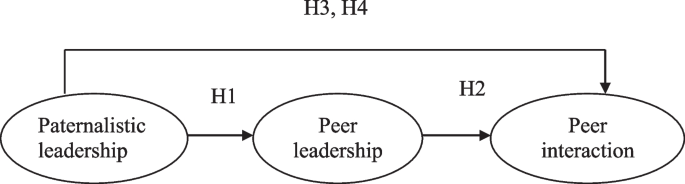
This study investigates the relationship between PL, PLD, and PIs among faculty in universities. To establish a strong theoretical foundation and clarify the relationships between these variables, this study integrates multiple theories: Paternalistic Leadership Theory, Leader-Member Exchange (LMX) Theory, and Social Identity Theory.
-
1.
Paternalistic Leadership Theory: Paternalistic leadership, as conceptualized, is characterized by authority, benevolence, and morality. These dimensions of PL are hypothesized to foster trust and cohesion among faculty members, laying the groundwork for effective PIs.
-
2.
Leader-Member Exchange (LMX) Theory: LMX theory emphasizes the quality of relationships between leaders and subordinates. It points out that high-quality exchanges result in greater collaboration and mutual respect. Within this framework, paternalistic leaders, through individualized support and clear moral guidance, elevate the LMX quality. In addition, it fosters the environments for PLD emergence. This PLD, in turn, acts as a bridge by means of facilitating stronger and more collaborative interactions among faculty.
-
3.
Social Identity Theory: Social identity theory, highlights the role of group membership in shaping individual behaviors and attitudes. In academic settings, a paternalistic leader’s ability to establish a shared group identity among faculty members encourages collective belongingness and cooperation. PLD amplifies this effect by reinforcing the shared identity through lateral support and influence. This ultimately enhances PIs.
-
4.
The Mediating Role of Peer Leadership: PLD is conceptualized as a mediator between paternalistic leadership and PIs. Drawing on Transformational Leadership Theory, peer leaders mirror the supportive and moral behaviors modeled by paternalistic leaders. In this way, they inspire their peers to collaborate and exchange ideas. This cascading effect demonstrates how leadership at the hierarchical level impacts horizontal relationships. They foster a collegial and synergistic academic environment.
Enhancements to the framework
-
1.
Integrative Perspective: The use of multiple theories (e.g., LMX and Social Identity) provides a more robust explanation of the dynamics between the variables.
-
2.
Mechanisms of Influence: Detailing how PL traits translate into PIs as PLD bridges the theoretical gap.
-
3.
Cultural Context: Including cultural considerations highlights the relevance and adaptability of these theories in different settings, such as faculties in collectivist societies.
link