The Skinny on Customer Journey Analytics Software in 2025

The Gist
- From visibility to action. Customer journey analytics transforms scattered touchpoint data into real-time, actionable insights that improve satisfaction, retention, and revenue.
- Beyond dashboards. Modern platforms like Adobe, Qualtrics and NICE now combine predictive AI, orchestration, and emotion analytics to help teams act while customers are still active.
- Integration is everything. Success depends on clean, unified data across CRM, CDP, web, and contact center systems — and on breaking down organizational silos that block true CX visibility.
- Metrics that matter. Companies must move beyond vanity metrics to KPIs tied to business outcomes like retention, CLV, and customer effort reduction.
- Implementation makes or breaks ROI. Effective journey analytics rollouts require data quality, cross-team ownership, continuous iteration, and alignment with long-term CX goals.
Customer journey analytics software aims to help businesseses understand, optimize and personalize every step of the customer experience. By aggregating and analyzing data from touchpoints across both digital and offline channels, these platforms reveal not just what customers do, but why they do it—and what will keep them coming back.
Customer journey analytics software has rapidly evolved from a niche reporting tool to a critical component of modern digital customer experience management. Today’s customer journey analytics platforms integrate real-time data, AI and visualization to empower teams to predict behavior and act on insights faster than ever.
Journey analytics has become essential for identifying pain points, uncovering hidden opportunities and driving measurable business outcomes. This guide breaks down what customer journey analytics is, why it matters, and how to choose the right software for your business.
Table of Contents
Customer Journey Analytics FAQ
Here are some of the most common questions about customer journey analytics—what it is, why it matters, and how to use it effectively. These answers will help you understand how journey analytics connects data, improves CX and drives measurable business impact.
What Is Customer Journey Analytics?
Customer journey analytics is both a discipline and a technology platform that enables businesses to visualize, track and analyze every step a customer takes across all digital and offline touchpoints. Unlike traditional web analytics, which mainly focuses on page views or clicks, or CX platforms that emphasize survey feedback, journey analytics connects the dots between channels, sessions and interactions to provide a unified, end-to-end view of the customer experience.
What is customer journey analytics? It’s the process of unifying data from all customer touchpoints to visualize and understand their journey. A customer journey analytics solution enables brands to identify the most common paths to conversion and uncover where customers encounter friction or drop off.
At its core, customer journey analytics software uses data from multiple sources—website visits, mobile apps, email, contact center logs, in-store interactions, and even third-party platforms. The system brings this information together and maps each customer’s journey, revealing the actual paths, sequences, and behaviors that drive outcomes.
Related Article: The Complete Guide to Customer Journey Mapping
From Visualization to Real-Time Decisioning
Journey analytics is no longer just about visualizing what has happened; its true value is as a springboard for action. Mike Bawn, vice president of digital experience transformation at TTEC Digital, told CMSWire, “The purpose has evolved from documentation to enablement. Where once the goal was understanding customer paths, now the goal is guiding them in real time toward better outcomes.”
What sets journey analytics apart is its ability to analyze journeys in real time, using AI and advanced segmentation to uncover friction points, identify bottlenecks, and detect opportunities for personalization. Instead of guessing why customers abandon carts churn, or become loyal advocates, businesses can see exactly which touchpoints and experiences shaped those outcomes.
Ultimately, customer journey analytics transforms scattered data into actionable insights, and delivers three core outcomes:
- Visibility: A complete, data-driven view of every customer’s path and experience
- Optimization: Evidence-based identification and removal of friction to improve conversions and customer satisfaction
- Personalization: The ability to tailor content, messaging and offers based on each customer’s actual behavior—not just demographic data
By going beyond isolated metrics, customer journey analytics enables businesses to understand not just what customers do, but why, and to drive more meaningful, profitable relationships at every stage.
Kaveh Vahdat, marketing and SEO expert, founder and president at RiseOpp, told CMSWire, “Customer journey analytics has moved from dashboards to decision support, and the platforms that matter in 2025 help teams understand where customers get stuck, why they drop off, and how to change the outcome while the customer is still active.”
Why Is Customer Journey Analytics Important?
Whether browsing online, connecting on social or speaking to a service agent, today’s customers move fluidly between channels, expecting personalized, pain-free experiences at every step. As digital touchpoints proliferate, so does the complexity of understanding what truly drives loyalty and business growth. Traditional analytics can’t keep up with these expectations; they capture isolated actions or feedback, but rarely reveal the full story.
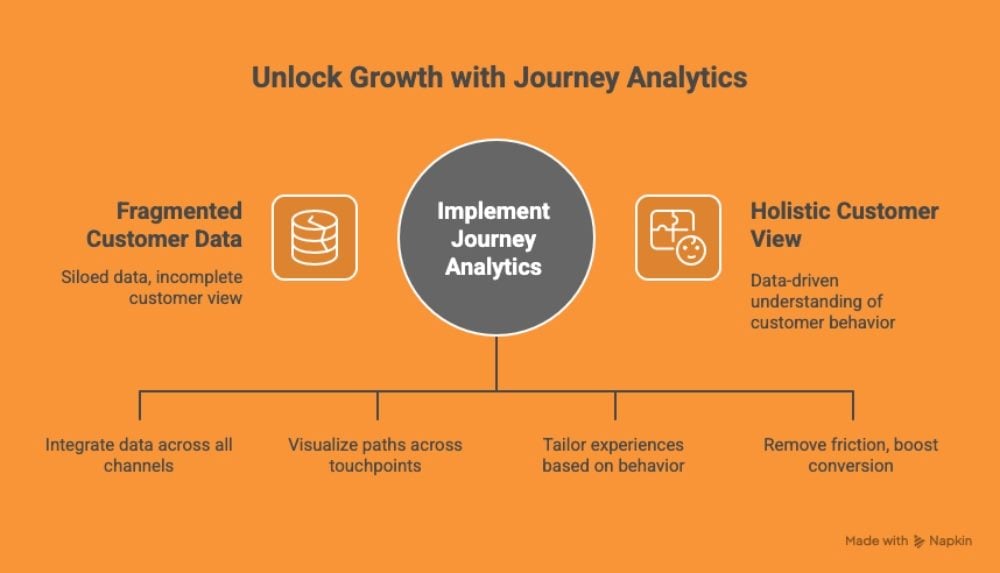
Customer journey analytics fills this gap by connecting fragmented data and mapping the real-world paths customers take across all channels. This unified view matters for several reasons. First, it enables true omnichannel personalization, tailoring interactions based not just on demographics, but on a customer’s actual behavior and intent across every touchpoint. When businesses understand each journey in context, they can deliver the right message, offer, or support at precisely the right moment.
How Journey Analytics Drives Measurable Impact
The business impact is direct and measurable. Businesses that embrace the functionality of journey analytics can identify and remove friction points that cause customers to drop off or churn, driving higher retention rates and long-term loyalty. By optimizing journeys, they also unlock new revenue opportunities, boost conversion rates, and increase customer lifetime value (CLV).
While journey analytics reveals paths and friction points, its real power is measured in customer outcomes and emotions. Bawn noted that “CX quality is reframed around how customers feel: do they feel known, helped, and valued?” This focus on emotional indicators, such as reduced effort, increased personalization, and heightened trust, moves the conversation beyond efficiency to genuine customer experience improvement.
Perhaps most importantly, journey analytics marks the shift from siloed, channel-specific data to a holistic, customer-centric approach. Instead of guessing what works, businesses gain a data-driven understanding of why customers behave the way they do, enabling them to act faster and smarter to improve every stage of the experience. In a world where customer expectations keep rising, journey analytics isn’t just important; it’s becoming essential for sustainable growth and competitive advantage.
Related Article: What Is Customer Experience (CX) and Why Does It Matter in 2025?
Customer Journey Analytics Market Growth in 2025
The customer journey analytics market is expanding rapidly, projected to surpass $35 billion by 2030, driven by increasing demand for real-time personalization and unified customer data platforms. Businesses investing in customer journey analytics tools are seeing measurable gains in retention and revenue, as these technologies become central to digital transformation initiatives.
Market Momentum and Adoption Trends
What do these platforms do? Help you build customer journey mapping strategies, for starters.
Industry Insights: Forrester’s 2024 Evaluation of Customer Journey Orchestration Platforms
A cousin, or some may say another name for customer journey analytics platforms, are customer journey orchestration platforms. In June 2024, Forrester released its report, The Forrester Wave™: Customer Journey Orchestration Platforms, Q2 2024, analyzing what it feels are the nine most significant providers based on 30 detailed criteria. The report positions customer journey orchestration (CJO) as the nerve center of a journey-centric business — connecting data, channels, and decisioning to deliver real-time, personalized experiences at scale.
Key Takeaways From Forrester’s 2024 Report
According to Forrester, the leading trend across the customer journey analytics market is the convergence of orchestration, AI and analytics. Vendors are infusing generative AI to understand context, surface friction and recommend actions, while prioritizing responsible data use and compliance. CX leaders evaluating customer journey analytics software should focus on three key takeaways from the report:
- Seamless data integration is non-negotiable. The most effective platforms fuse online and offline data sources in real time to reveal the complete customer journey, enabling faster insight-to-action.
- Responsible AI drives better outcomes. Forrester highlights that leading vendors combine predictive and generative AI to guide ethical, transparent decision-making and build trust in personalization at scale.
- Outcome-based measurement matters. Instead of focusing solely on completion or Net Promoter Score (NPS), modern orchestration tools measure journey health, profitability and emotion across customers, employees and partners.
The evaluation identified Leaders, Strong Performers, Contenders and Challengers — each offering unique capabilities for enterprises aiming to mature their journey orchestration strategies. The following table summarizes the vendors featured in the report and highlights some of their distinctive features:
| Vendor | Homepage | Key Features Highlighted by Forrester |
|---|---|---|
| Alterian | alterian.com | Real-time CX platform, AI-powered journey insights, instant onboarding and preloaded orchestration playbooks. |
| CSG Xponent | csgi.com | Comprehensive data fusion, maturity modeling, real-time decisioning and generative AI-driven customer bill explanations. |
| Qualtrics | qualtrics.com | Emotion analytics, sentiment and text analysis, generative AII-powered journey atlas and integrated CX-EX dashboards. |
| Genesys Cloud CX (Pointillist) | genesys.com | Journey management with intent detection, AI-driven speech analysis and advanced journey flow visualization. |
| Medallia (Thunderhead ONE) | medallia.com | Real-time orchestration, AI-driven decisioning and dynamic intelligence for contextual, event-based customer engagement. |
| Engage Hub | engagehub.com | AI-powered cross-channel communications, NLP-based automation and deep contact-center integration. |
| inQuba | inquba.com | Journey profitability tracking, value measurement and digital nudge strategies for reducing drop-offs. |
| Quantum Metric | quantummetric.com | Session replay analytics, journey storytelling, and generative AI-based session summarization for experience optimization. |
| Roojoom | roojoom.com | AI-powered customer care journeys, predictive journey AI and self-service optimization for support experiences. |
Collectively, these vendors represent the evolution of the customer journey analytics landscape — where orchestration, analytics and AI intersect to shape next-generation customer experience strategy. CX and marketing leaders can use Forrester’s evaluation as a starting point to benchmark vendors, assess integration depth, and identify solutions that best align with their organization’s data and decision-making maturity.
Key Features to Look For in Journey Analytics Software
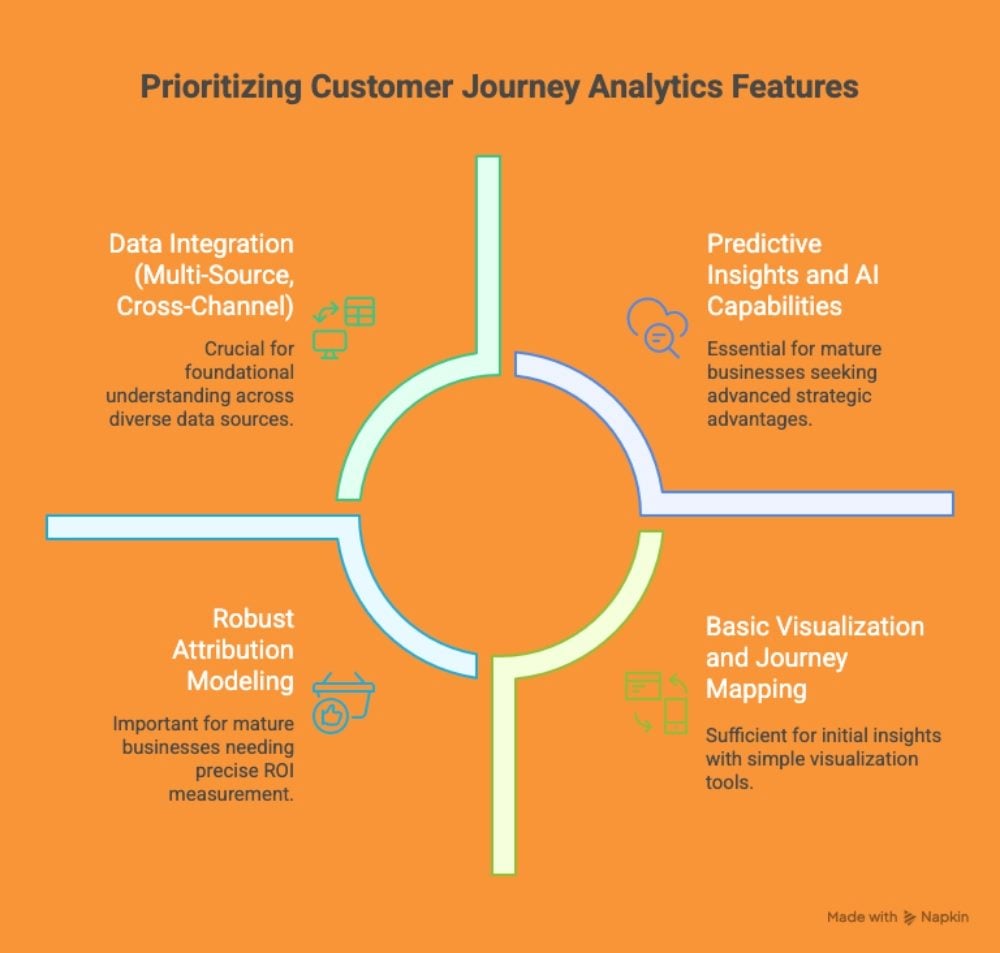
Choosing the right customer journey analytics platform means looking beyond the basics. The most effective solutions bring together data, visualization, real-time analysis and actionable intelligence to turn complex journeys into clear, profitable outcomes.
Matching Platform Capabilities to Business Maturity
Choosing the right customer journey analytics platform depends on scale, data complexity, and activation needs. From enterprise-grade systems like Adobe Customer Journey Analytics to specialized customer journey analytics tools for smaller teams, each offers unique advantages in visualization, orchestration and predictive modeling.
Here’s what to prioritize with customer journey analytics software:
Data Integration (Multi-Source, Cross-Channel)
A strong journey analytics tool must pull in data from every relevant source, including websites, mobile apps, email, call centers, in-store systems, Customer Relationship Management (CRM) platforms, and more. Pain-free integration enables a complete, accurate picture of the customer experience, breaking down data silos that hide crucial insights.
Visualization and Journey Mapping
Look for platforms that make it easy to visualize customer paths. Intuitive dashboards and journey maps help teams spot trends, identify friction points, and share insights across departments. The best solutions allow you to drill down from a macro view to the individual customer level, revealing both common patterns and unique journeys. Here is such an example from Adobe’s Customer Journey Analytics platform:
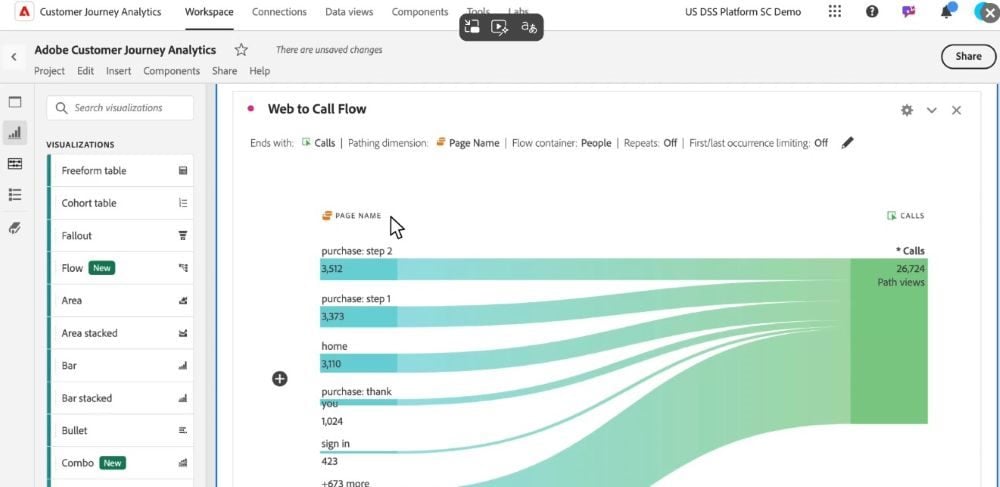
Today’s journey analytics tools are rapidly moving beyond static dashboards to deliver actionable, AI-powered insights. For businesses working with large, complex datasets, the ability to interact directly with embedded AI, rather than relying on manual interpretation, accelerates understanding and unlocks new levels of business value.
Phurba Sherpa, director of ecommerce at Wrist Aficionado, told CMSWire, “When selecting software in 2025, your focus should be on leveraging AI to help you make better decisions on how user experience is impacting various areas. For example, we use Microsoft Clarity, and inside Clarity, it has features where you can talk with the AI chatbot and understand user behavior and experience in depth,” said Sherpa. “This helps if you are working with larger data and want to truly understand the user journey.”
Real-Time Analytics and Segmentation
Today’s customers expect fast, relevant interactions. Journey analytics software should provide real-time data processing, enabling users to react instantly to emerging behaviors or issues. Advanced segmentation tools let you filter journeys by customer segment, channel, device, or outcome, all of which are essential for targeted optimization.
Predictive Insights and AI Capabilities
Leading platforms do more than display historical data; they use real-time analytics and predictive AI to forecast behavior and trigger timely interventions. As Bawn put it, “Journey orchestration…produces measurable CX quality gains—less about static KPIs and more about operational capabilities that turn insight into impact.” The ability to automate intelligently and adapt based on unified, real-time data is now essential.
Customer Journey Analytics Examples in Action
Leading brands are using customer journey analytics software to uncover patterns that traditional analytics miss. For instance, a global retailer identified that customers who contacted chat support within 24 hours of viewing a return policy were twice as likely to complete a purchase. In another customer journey analytics example, a financial institution used cross-channel data to reduce onboarding drop-offs by 18% through personalized messaging informed by journey mapping.
Attribution Modeling
To truly understand ROI, the software should include robust attribution capabilities. This allows you to measure the impact of each touchpoint and campaign on customer decisions, so you can invest resources where they matter most.
Privacy and Compliance Considerations
With growing regulations around data privacy, ensure any journey analytics solution offers strong compliance features. Look for tools that support consent management, data anonymization, and flexible data residency controls to protect both your customers and your brand.
By focusing on these core features, businesses can move beyond basic reporting and unlock the full power of customer journey analytics—turning raw data into real business impact, with transparency and trust built in from the start.
How Does Customer Journey Analytics Differ From Other Analytics Tools?
Customer journey analytics stands apart from traditional analytics solutions by focusing on the end-to-end experience across all touchpoints—not just isolated actions or siloed data. Here’s how it differs from other common tools in the customer experience (CX) and marketing tech stack:
Web analytics platforms, such as Google Analytics (part of Google Marketing Platform) and Microsoft Clarity, are designed to track page views, clicks and user behavior on websites and apps. While they provide valuable insights into digital engagement, they’re typically limited to single sessions or channels and can’t connect online interactions with offline or cross-channel behaviors. Journey analytics, in contrast, weaves together data from every channel—digital and physical—offering a holistic view of each customer’s complete experience.
CDPs excel at aggregating and unifying customer data from disparate systems, creating a single customer profile for segmentation and activation. However, most CDPs focus on data collection and identity resolution rather than on mapping and analyzing the actual journeys customers take. Journey analytics builds on unified data, uncovering the paths, patterns, and friction points that shape outcomes.
CRM systems track customer interactions and manage relationships, providing reporting on sales pipelines, service tickets, or campaign engagement. These reports are often limited to specific functions—such as sales or support—and don’t visualize the customer’s journey across all departments and channels. Journey analytics bridges these silos, connecting the dots to show the true flow of customer experience.
When to Use Each Solution—and When to Integrate
Web analytics is ideal for optimizing website performance or digital marketing campaigns. CDPs are essential for building unified customer profiles and powering personalized marketing. CRM reporting helps manage and analyze sales, service, and support activities.
Journey analytics is the tool of choice when you need to understand the bigger picture—how customers move across touchpoints, where they encounter friction, and which journeys drive business value. For businesses seeking a comprehensive, actionable understanding of customer experience, integrating journey analytics with CDPs, web analytics and CRM platforms delivers the deepest insights and greatest business impact.
Top Customer Journey Analytics Software for 2025
Below is a look at some of the platforms in the customer journey analytics space in 2025:
- Built on its Experience Platform, Adobe Customer Journey Analytics connects identities and interactions across channels, devices, and time, providing business teams with self-serve, drag-and-drop journey analytics plus activation via its broader ecosystem. Stand-out: Real-time large-scale data processing, strong integration with marketing & activation workflows, and enterprise governance capabilities.
- Qualtrics Customer Journey Analytics offers journey analytics as part of its larger experience management (XM) platform with an emphasis on feedback, sentiment, and customer emotion, combined with behavioral data. Stand-out: Deep feedback and VoC (voice of customer) integration, strong in mapping and transforming customer emotions into journey insights.
- Genesys Cloud CX now includes advanced journey analytics and orchestration capabilities, integrating features from the former Pointillist platform. As of July 2026, Genesys will end support for Pointillist as a standalone product, consolidating its strengths into Genesys Cloud for a unified approach to journey management. Stand-out: Advanced journey analytics, real-time orchestration, and deep integration across contact center, digital, and voice channels—now under one cloud-native platform for future-proof scalability.
- Glassbox offers a digital experience analytics platform that captures 100% of web and mobile app user sessions, visualizes entire customer paths via journey maps, and uncovers friction points with AI-driven insights in real time. Stand-out: Particularly strong for businesses that are focused on digital-first experiences, its session-replay, journey-map, and quantitative insight capabilities make it ideal for uncovering why customers drop off and how to fix it quickly.
- NICE Customer Journey Analytics unifies operational and experiential data across digital, voice, and contact center touchpoints to provide a complete, real-time view of customer behavior. Its AI-powered analytics engine identifies friction points, predicts next-best actions, and enables businesses to orchestrate personalized journeys at scale. Stand-out: Particularly well-suited for enterprises with complex contact center operations or service-centric business models. NICE excels in using interaction analytics and automation to boost customer satisfaction, retention, and operational efficiency.
Essential Features of Leading Customer Journey Analytics Platforms
| Platform | Core Orientation | Key Differentiators | Best For |
|---|---|---|---|
| Adobe Customer Journey Analytics | Enterprise, omnichannel analytics | Real-time processing, strong data and marketing integration, enterprise governance | Large enterprises, teams needing deep activation and analytics |
| Qualtrics Customer Journey Analytics | Experience management and feedback | Voice of Customer integration, emotion analytics | Customer-centric businesses, VoC-heavy teams |
| Pointillist (Genesys) | Journey orchestration, visualization | Predictive modeling, actionable journey mapping | Firms needing real-time orchestration and deep path analysis |
| Thunderhead ONE (Medallia) | Intent-driven, real-time orchestration | Intent signals, omnichannel journey unification | Service-heavy, omnichannel environments |
| NICE Customer Journey Analytics | Contact center and operational data | Contact center focus, voice and operational data fusion | Service-centric businesses, voice-heavy CX |
Among all customer journey analytics solutions, Adobe Customer Journey Analytics continues to set the standard for real-time, enterprise-scale insights that connect data from marketing, sales, and service systems.
How to Choose the Right Customer Journey Analytics Solution
Selecting the ideal customer journey analytics platform is less about chasing the latest features and more about aligning the technology with your brand’s goals, resources, and digital ecosystem. Here’s what to consider as you evaluate your options:
Start by clarifying your most pressing customer experience challenges. Is your goal to unify data across multiple channels, identify friction points in complex journeys, or drive real-time personalization? Consider your company’s size, industry, and digital maturity. Enterprises with advanced martech stacks may prioritize deep analytics and orchestration, while smaller businesses might value ease of use and quick time to value.
A journey analytics tool only delivers value if it can connect with your current systems—CRM, CDP, web analytics, contact center, marketing automation—without friction. Evaluate integration options, data connectors and API capabilities. The right platform should fit naturally into your tech stack, minimizing the need for costly custom work or disruptive rip-and-replace projects.
As your business grows, so will the volume and complexity of customer data. Choose a solution that can scale with your needs, handling increases in users, data sources, and analytics demands. Don’t overlook vendor support: look for proven onboarding processes, responsive customer service, training resources and a roadmap that matches your long-term goals.
Don’t commit to a platform sight unseen. Arrange for demos tailored to your use cases, and if possible, run a pilot with real business data. This hands-on experience is the best way to judge usability, performance, and the depth of actionable insights. Involve both technical and business users in testing, and ask for references from similar businesses.
By grounding your decision in real business needs and thoroughly vetting each solution’s fit and flexibility, you’ll be positioned to choose a journey analytics platform that not only delivers on today’s requirements but grows with you, driving better outcomes for both customers and the business.
Did you know? Companies that integrate customer journey analytics platforms with their CRM and CDP systems report 2.5x higher marketing ROI and 30% faster resolution of customer friction points, according to Gartner research.
Implementation Best Practices for Customer Journey Analytics
Rolling out a customer journey analytics solution requires more than just flipping the switch on new software. Success depends on careful preparation, clear ownership, and a commitment to continuous improvement. Here’s how to set your project up for real impact:
- Prioritize Data Quality and Effective Onboarding: Audit and clean data before launch so journey maps are accurate, not just easy. Collaborate closely with vendors during onboarding to set up data pipelines and key metrics that reflect real business goals.
- Invest in Change Management: Engage cross-functional teams early, communicate the project’s value, and provide hands-on training. Appoint journey analytics champions and celebrate early wins to build buy-in.
- Measure Impact and Iterate: Define clear success metrics from the start, track them consistently, and use analytics insights to test and improve. Continuously iterate your approach as needs evolve.
Making Data Quality a Long-Term Discipline
Vahdat told CMSWire, “The priority is clean event data, consistent identity across devices, and a direct link from insight to action, not more volume,” said Vahdat. “Companies run into trouble when they treat data quality as a one-time integration task instead of an ongoing discipline, which is why shared event definitions and clear ownership beat expensive tooling every time.”
Common Pitfalls and How to Avoid Them in Customer Journey Analytics
Vahdat emphasized that the most common mistake is acting on correlation without validation, so the companies that get results pair journey insights with controlled tests and measure success in business outcomes like repeat rate and cost to serve. Other challenges of customer journey analytics implementation include:
Customer Journey Analytics: Benefits vs. Common Pitfalls
| Benefit | How It Helps | Common Pitfall | How to Avoid |
|---|---|---|---|
| Complete journey visibility | Unifies all touchpoints, showing the full CX | Data silos, incomplete integration | Prioritize integration, involve IT and business teams |
| Real-time personalization | Delivers targeted, relevant experiences instantly | Slow data pipelines, outdated segments | Invest in real-time analytics and up-to-date models |
| Measurable impact on retention and revenue | Reduces churn, lifts conversions, boosts CLV | Misaligned KPIs, vanity metrics | Tie analytics to true business outcomes |
| Actionable insights | Turns complex journeys into clear recommendations | Underutilization, data overwhelm | Create feedback loops, review insights regularly |
| Privacy and compliance support | Protects customer data, supports regulation | Weak compliance, regulatory risk | Demand robust compliance features |
Data Silos and Integration Headaches
Breaking Down Silos to Improve Collaboration
One of the most frequent obstacles to successful journey analytics is fragmented data locked in departmental silos. When analytics platforms can’t access or unify all relevant data sources, the resulting insights are incomplete and can lead to misguided decisions. To avoid this, prioritize solutions with robust integration capabilities and make cross-functional collaboration a core part of your rollout plan. Break down internal barriers by involving IT, marketing, service and operations teams from day one.
The most persistent barriers to effective journey analytics aren’t technical—they’re organizational. Legacy business structures often create silos where critical data is fragmented and teams fall back on “the way we’ve always done things.” Transforming the business around the customer, rather than channels or departments, is essential for unlocking the true value of journey analytics.
Shekar Raman, customer engagement expert, CEO and co-founder at Birdzi, suggested, “Breaking down internal silos starts with transforming the organization. Today, many businesses are organized around functions, so the shopper tends to live in the marketing stack or loyalty/CRM. This is where the silos form,” said Raman. “Businesses should reorganize their structure around the shopper instead. In grocery retail, for example, in addition to a ‘cereal’ category manager, the retailer can create a ‘gold customer’ category manager, or a ‘young families’ category manager. This drives everything back to the shopper and sets up each function to support.”
Misaligned KPIs in the Customer Journey
It’s a challenge not to fall into the trap of measuring what’s easy, rather than what matters. Relying on vanity metrics or channel-specific KPIs can obscure the real drivers of customer experience and business value. Instead, work with stakeholders to define KPIs that are directly tied to desired outcomes—such as customer retention, lifetime value, or successful journey completion. Align analytics efforts with these strategic goals to ensure insights drive meaningful action.
Underutilization of Insights
Even the most powerful journey analytics platform won’t deliver results if its insights aren’t put to use. Sometimes, teams get overwhelmed by the volume of data, or lack clear processes for acting on findings.
Turning Analytics Into Action
Encourage a culture of experimentation and accountability: create clear feedback loops between analytics teams and business owners, regularly review key insights in cross-functional meetings, and establish workflows to turn analysis into concrete improvements.
Choosing the Best Customer Journey Analytics Solution
Whether you’re evaluating customer journey analytics software for the first time or upgrading your existing customer journey analytics tools, the goal remains the same: turning complex data into clarity. The right customer journey analytics solution provides unified visibility across every interaction, helping businesses build trust, personalization, and measurable growth at scale.
Turning Insights Into Outcomes
Customer journey analytics software has become essential for businesses seeking to understand, optimize, and personalize every step of the customer experience.
From Data to Continuous Experience Improvement
By unifying data across channels, uncovering actionable insights, and enabling real-time improvements, these platforms enable teams to break down silos, address pain points, and drive meaningful business outcomes. As brands look to build stronger relationships and adapt to ever-changing expectations, journey analytics stands out as a powerful tool for transforming raw data into better experiences and lasting growth.
link