How do leadership styles influence employee engagement and performance in SMEs?
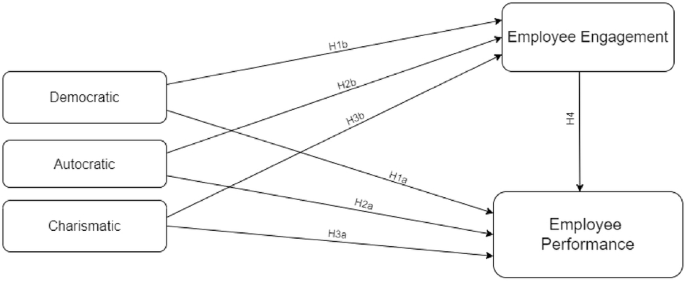
Studies of leadership in organizational environments demonstrate that leadership has a significant influence on employee performance and engagement, while different leadership approaches yield varying results. Research demonstrates that the autocratic leadership style produces mixed results in organizational settings. Autocratic leadership approaches have historically compromised employee freedom and involvement at work.
The acceptance of autocratic leadership by team members under certain circumstances leads to psychological safety, which in turn results in better performance through the maintenance of an organized and predictable workplace (Al Khajeh, 2018). The authoritarian leadership style offers advantages to organizations that require stability through swift decision-making and clear directives. Autocratic leadership offers efficiency and performance gains to SMEs with well-defined roles and limited resources, thanks to its structured approach.
The short-term performance gains achieved through autocratic leadership ultimately come at the expense of unfavorable long-term employee engagement outcomes. Employee autonomy, along with creativity, tends to decrease under centralized control, resulting in dissatisfied staff who disengage and potentially leave the organization. Autocratic leadership produces its most significant performance advantages in scenarios where maintaining stability and operational efficiency takes precedence over employee-generated ideas and input.
The primary benefits of autocratic leadership are most evident in organizational structures that prioritize stability over employee autonomy or innovation. The performance advantages that autocratic leadership delivers during short periods often conflict with the sustainability of employee engagement, particularly when organizations need creative employee contributions.
Charismatic leadership: Substantial research shows that charismatic leadership has a significant positive effect on both employee engagement and performance results. Through an inspiring vision, charismatic leadership enables employees to develop a deep emotional commitment and a strong sense of purpose (Juliarti, 2022). The emphasis on vision, combined with personal appeal, through this leadership style, enhances employee engagement while increasing performance levels as workers strive to surpass expectations to achieve common goals.
Studies have shown that charismatic leadership yields superior results in performance-based outcomes. Leadership vision, developed through motivation and emotional connections within the team, is a key aspect of charismatic leadership that significantly influences organizational outcomes and alters employee actions (Shamir et al. 1993). Charismatic leadership benefits organizations when leaders align individual targets with organizational objectives, thereby fostering increased employee engagement and productivity (Bass and Riggio, 2006).
Under charismatic leadership, employees put forth additional work beyond their basic responsibilities because their leaders establish demanding standards that both parties work to achieve (Bennis, 2009). The shared organizational goals and values between employees and leaders foster high motivation, leading to improved performance outcomes throughout the organization. The ongoing impact of charismatic leadership approaches reveals vulnerability, according to research findings. Leadership performance diminishes when personal appeal decreases, leading to reduced employee motivation and performance (Yukl, 2010). The long-term effectiveness of charismatic leadership remains a topic of ongoing research despite its apparent advantages. The enduring effects of charismatic leadership on engagement and performance depend on both the leader’s appeal and the maintenance and alignment of their objectives with those of the organization.
Democratic leadership encourages active participation in decision-making, which is linked to higher levels of engagement and job satisfaction (Nabella, 2022). This style’s inclusivity fosters a collaborative environment that supports adaptive learning and transformation within organizations (Al-Yami et al. 2018). Studies indicate that democratic leadership has a positive impact on performance by empowering employees, which aligns with the findings in this study, demonstrating the positive effects of democratic leadership on both employee engagement and performance.
Employee engagement as a mediator
The mediating role of employee engagement in the relationship between leadership styles and performance is well-established in the literature. Employee engagement, characterized by vigor, dedication, and absorption in work, is crucial for enhancing organizational outcomes and driving productivity (Schaufeli et al. 2002; Saks, 2006). Leaders who create supportive and engaging work environments secure employees’ emotional and cognitive investment, leading to higher performance levels (Schneider, 2008; Anitha, 2014).
Democratic leadership, which emphasizes employee participation in decision-making, fosters engagement by creating a workplace where employees feel valued and heard (Lewin et al. 1939). This empowerment enhances intrinsic motivation, particularly in organizations where creativity and innovation are core values (Amabile, 1997). The performance benefits of democratic leadership are realized through the creation of cooperative teams that improve problem-solving outcomes. However, the effectiveness of democratic leadership depends on an organization’s maturity and ability to handle decision-making delays, which may hinder rapid action when needed.
Employee engagement serves as a mediator, strengthening the connection between leadership styles and performance. Engagement reflects the extent to which employees emotionally invest in their work, thereby influencing their contributions to organizational goals. Engaged employees exhibit higher discretionary effort, resulting in improved performance (Saks, 2006). Leadership behaviors have a significant impact on engagement, with transformational and participative styles yielding superior engagement outcomes compared to directive approaches (Schaufeli et al. 2002). Leadership that empowers and motivates employees fosters a dedicated and active workforce, thus enhancing performance (Rich et al. 2010).
In summary, leadership styles play a crucial role in fostering employee engagement, which in turn directly impacts performance outcomes. Charismatic leadership is the most impactful for both engagement and performance, as it focuses on emotional connection. In contrast, democratic leadership fosters engagement by empowering employees to participate in and take ownership of their work. Autocratic leadership, though less effective for engagement, can achieve performance goals in controlled environments through clear directives. Employee engagement serves as the crucial link between leadership approaches and performance, with success contingent upon the organizational context and the needs of employees.
Employee performance is the result of an organization’s collaboration with its employees. Employee performance also refers to the degree of achievement or results achieved by employees who accomplish the work assigned to them by the company. The performance also indicates the amount of work executed on job responsibilities assigned by the organization, sourced according to their respective fields (Wardhana et al. 2022).
Theoretical and hypothesis development
The influence of democratic leadership style on employee performance
According to Andarista et al. (2021), the basic principle of democratic leadership style is the prioritization of collective decision-making over individual authority. The approach suggests that team member input should be considered at least equal to, and possibly even superior to, that of the leader during participatory decision-making. The democratic leadership approach promotes teamwork and creates joint decision-making and execution responsibility, demonstrating that leadership tasks extend beyond providing direction to developing group accountability. The assumption transforms conventional leadership structures, which bestow exclusive authority and decision-making power to the leader position.
According to Chua et al. (2018), the democratic leadership style fosters team member development by emphasizing active participation from team members. The model considers participation as a growth-enabling element rather than treating it as a mere inclusion practice. The democratic leadership style provides people with opportunities to make decisions, which helps them develop essential skills and increases their sense of competence while boosting their confidence. Through active involvement, members develop stronger team bonds while increasing their creativity as they both submit their thoughts and take responsibility for their duties (Banda et al. 2024a). The democratic leadership model demonstrates that leadership growth involves the simultaneous development of personal growth alongside team objective achievement.
The set of assumptions reveals that democratic leadership emphasizes both empowerment and collaborative approaches, distinguishing it from authority-based or transactional leadership models. The practical deployment of these assumptions requires leaders to evaluate both organizational culture and team characteristics, as well as the balance between decision-making efficiency and group agreement. The potential for member development through democratic leadership is significant; however, it requires thoughtful application because it does not work equally well across all organizational contexts.
H1a: Democratic leadership has a positive impact on Employee performance.
The influence of charismatic leadership style on employee performance
A leader who employs the charismatic style profoundly influences their followers by creating a compelling image of their beliefs and vision. Firdaus et al. (2023) explain that followers maintain complete faith in their leader and demonstrate intense emotional commitment to both organizational goals and leadership direction. The attachment between followers and the leader runs deep because it inspires followers to strive for organizational excellence while setting challenging performance targets. The emotional dedication of followers fosters a strong work ethic, accompanied by increased confidence and an enthusiastic pursuit of organizational targets, which optimizes team performance.
The emotional side of followership interaction grows stronger through charismatic leadership, as it connects with followers’ psychological preferences beyond rational informational appeals. Akbar et al. (2024) point out that follower devotion towards charismatic leaders develops unconsciously because people underestimate the depth of influence their leaders have. The intangible force of charismatic leadership enables the successful mobilization of performance among people without requiring direct control or extensive behavioral directives. Research acknowledges these leadership effects, but the underlying processes through which charm-based leaders generate followers’ loyalty prove difficult to measure.
The motivation of followers under charismatic leadership stems from their genuine emotional bond with the vision presented by their leader rather than their leader’s authoritative position. The emotional bond between leaders and followers produces better performance results because leaders effectively match their skills with organizational goals. Based on these conceptualizations, it is hypothesized that
[H3a:] Charismatic leadership has a positive impact on Employee performance.
However, the nature of this influence may vary depending on contextual factors such as the organizational culture and the leader’s ability to maintain their charismatic appeal.
The influence of autocratic leadership style on employee performance
Authoritarian leadership focuses on defining specific goals and exercising rigorous decision-making authority to create efficient work environments with disciplined subordinates. Cheng et al. (2000) and Schaubroeck et al. (2017) suggest that authoritarian leaders achieve focus and reduce confusion by providing unambiguous objectives. Specific goals lead to better performance, according to Locke and Latham’s (2006) goal-setting theory, since employees can track their advancement through objective measures. Within environments that require structured or routine work, authoritarian leadership fosters clarity and oversight, resulting in productive outcomes. People are more willing to achieve shared institutional goals and implement organizational policy when they feel included (Banda et al. 2024b).
The short-term increase in work efficiency through authoritarian leadership comes at the expense of unfavorable long-term consequences. Employee input and autonomy deprivation lead to suppressed creativity and intrinsic motivation, resulting in decreased job satisfaction and lower organizational commitment among staff members. Strict monitoring tends to produce rule-followers instead of innovative thinkers, resulting in inferior outcomes in changing circumstances.
Thus, this study hypothesizes, as shown in Fig. 1, that
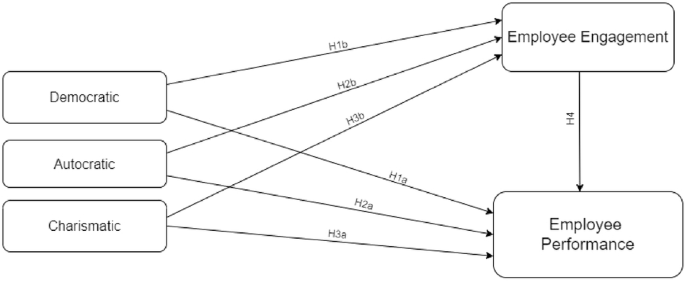
H2a: Autocratic leadership has a negative impact on Employee performance.
link