The electricity purchasing and selling strategy of load aggregators participating in China’s dual-tier electricity market considering inter-provincial subsidies
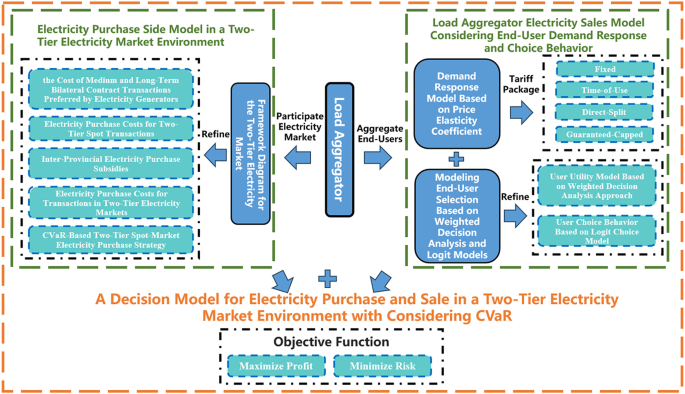
In this paper, we propose an electricity purchasing and selling decision model for load aggregators in China’s dual-tier electricity market environment, as shown in (Fig. 1). The model consists of two main components: an electricity purchase side model for load aggregators, and an electricity sales model that takes into account end-user demand response and choice behavior. This decision-making model employs the Conditional Value at Risk (CVaR) model to quantify market risks. It not only takes into account the market risks in the financial market (such as price fluctuations, supply and demand changes, etc.), but also fully considers the risk perception and preferences of end users. The objective function is the difference between the revenue of the electricity selling model part and the cost of the electricity purchasing model part, aiming to maximize profits and minimize risks, thereby providing decision support for load aggregators in participating in the dual-tier electricity markets at both provincial and inter-provincial levels in China.
In the construction of the electricity purchase side model, the framework for load aggregators to participate in the dual-tier electricity market is first clarified. Second, under this framework, three models are developed: a transaction cost model for medium and long-term bilateral contracts that takes into account the preferences of generators, a model for the cost of purchasing electricity in dual-tier spot transactions, and a model for inter-provincial electricity purchase subsidies, which together constitute a model of the cost of purchasing electricity for transactions in the dual-tier electricity market. Finally, the conditional value-at-risk-based dual-tiered spot market electricity purchase strategy combines spot costs with electricity purchase strategy. In the electricity sales model, the demand response and selection behavior of the end-users is considered to calculate the revenue from the sale of electricity by the load aggregators. The framework combines a demand response system utilizing price elasticity with a consumer selection method based on weighted Logit decision analysis. Among them, the demand response model provides load aggregators with a variety of electricity packages to their aggregated end-users, including fixed tariff packages, time-of-use tariff packages, direct split tariff packages, and guaranteed capped tariff packages; while the end-user choice model constructs an end-user utility model through a method based on weight-based decision analysis, and combines it with a Logit model to simulate end-users’ choice behaviors, in order to compute the choice of likelihood of each electricity package.

Decision model for electricity purchasing and selling in a dual-tier electricity market environment for load aggregators framework.
Electricity purchase side model in china’s dual-tier electricity market environment
Load aggregators participate in China’s dual-tier electricity market, which is divided into inter-provincial market and intra-provincial market based on spatial scale. Both of them jointly ensure the supply of electricity and the optimal allocation of resources. The trading framework is shown in (Fig. 2). The inter-provincial electricity market aims to promote the optimal allocation of power resources and the absorption of renewable energy, and the trading time is divided into medium-term market (including annual and monthly contracts) and spot market (including day-ahead and intra-day markets); while the intra-provincial market includes bilateral contract trading and spot trading of medium term and spot markets to achieve the effective allocation of intra-provincial power resources. Under the trading framework of the dual-tier market, load aggregators can independently choose the type of trading market, either participating in the intra-provincial market or simultaneously participating in the inter-provincial market. The inter-provincial electricity market is based on the prediction results of the provincial electricity balance, and the trading should be conducted earlier in time than the intra-provincial market, and its trading results play a role in limiting the boundaries of the intra-provincial market. Therefore, load aggregators can participate in the medium-term bilateral contracts of both the inter-provincial and intra-provincial markets before the spot market opens. After the inter-provincial spot trading is organized by the National Electricity Exchange Center, the provincial electricity exchange center is responsible for organizing the intra-provincial spot trading to ensure the smooth progress of the multi-level and multi-regional coordinated trading process.

Framework diagram for load aggregators to participate in China’s dual-tier electricity market.
Load aggregators, as the main purchaser of electricity on the customer side, participate in four electricity markets covering the inter-provincial medium- and long-term market, the intra-provincial medium- and long-term market, the inter-provincial spot market and the intra-provincial spot market. In these markets, electricity purchases are coupled to each other regarding the cost of purchasing electricity. In China’s dual-tier electricity market environment, the load aggregator’s electricity purchase decision model takes into account the transaction costs of inter-provincial medium- and long-term bilateral contracts, the transaction costs of the province’s medium- and long-term bilateral contracts, the transaction costs of the inter-provincial spot market, the transaction costs of the province’s spot market, and the subsidies for inter-provincial electricity purchases. The model aims to minimize total transaction costs by adjusting the amount of electricity purchased in different markets. In this model, bilateral contract trading focuses on generator preferences, spot trading focuses on electricity balancing, and inter-provincial electricity purchase subsidies are related to the share of electricity purchased and the share of renewable electricity consumed. Considering the uncertainty of spot trading and congestion pricing, load aggregators can establish a dual-tier spot market electricity purchasing strategy based on CVaR. In addition, by analyzing historical data from the electricity markets, load aggregators are able to assess the transaction costs and associated risks in each market to make more informed electricity purchase decisions.
The cost model of medium and long-term bilateral contract transactions preferred by electricity generators
Load aggregators secure medium and long-term bilateral agreements with electricity generators across provincial lines, hammering out the details through the electricity market well in advance. These contracts lock in both the volume and cost of electricity to be procured for future periods, with pricing heavily influenced by regional generators’ preferences for the purchase curve. Essentially, the more the purchase curve aligns with a generator’s ideal curve, the lower the electricity purchasing price \({p_{CB/PB,k}}\) tends to be, as outlined in Eq. (1).
$$p_{{CB/PB,k}} = \left( {1 + a_{k} \mathop \sum \limits_{{t = 1}}^{T} \left| {\frac{{Q_{{k,t}} }}{{Q_{k} }} – r_{{k,t}}^{0} } \right|} \right)p_{k}^{0}$$
(1)
Where, there are K provinces in the electricity market. \(p_{k}^{0}\) represents the agreed-upon base price in the bilateral contract between he load aggregator and the electricity generator of provinc k during time period t, essentially the rate at which electricity is procured when the purchase curve aligns with the generator’s preferences. \({Q_{k,t}}\) denotes the volume of electricity the load aggregator secures from from the electricity generator of province k under medium and long-term contracts within time period t. \({Q_k}\) signifies the cumulative electricity volume purchased by the load aggregator from the electricity generator of province k across all medium and long-term contracts. Lastly, \(r_{{k,t}}^{0}\) reflects the proportion of electricity sales within the total sales from the electricity generator of province k preference curve during time period t, as defined by \(\mathop \sum \limits_{{t = 1}}^{T} r_{{k,t}}^{0} = 1\). \(\mathop \sum \limits_{{t = 1}}^{T} \left| {\frac{{Q_{{k,t}} }}{{Q_{k} }} – r_{{k,t}}^{0} } \right|\) represents the extent to which the load aggregator’s electricity purchase curve differs from the generator’s preference curve for province k in time period t. \({a_k}\) denotes the sensitivity coefficient of electricity generators’ preferences. The sensitivity coefficient is positively related to the sensitivity of generators to the preference curve. It can be fitted based on the historical negotiation data between the load aggregator and the electricity generators in each province.
Load aggregators make judgments about transaction costs as well as market risk based on historically recorded market information. For inter-provincial bilateral agreements, transmission fees apply, and electricity delivery faces potential congestion risks. The relevant cost is shared by the electricity generator and the load aggregator, and the proportion of sharing is determined by negotiation. There are a total of S modes for electricity with historical data for congestion costs. Each mode corresponds to a set of historical electricity prices. The transaction cost \(C_{{CB,k}}^{s}\) for medium and long- term bilateral contracts is calculated by Eq. (2).
$$\begin{aligned} C_{{CB,k}}^{s} & = C_{{CB,k}}^{\prime } + C_{{CB,k}}^{{\prime \prime }} + C_{{CB,k}}^{{\prime \prime \prime s}} \\ & = \mathop \sum \limits_{{t = 1}}^{T} p_{{CB,k}} Q_{{k,t}} + \mu _{{k1}} \mathop \sum \limits_{{t = 1}}^{T} p_{{CB,k}}^{{Tr}} Q_{{k,t}} + \mu _{{k2}} \mathop \sum \limits_{{t = 1}}^{T} \Delta p_{{CB,k}}^{{s,t}} Q_{{k,t}} \\ \end{aligned}$$
(2)
Where, \(C_{{CB,k}}^{\prime }\) represents the expense the load aggregator incurs when purchasing electricity from province k. \(C_{{CB,k}}^{{\prime \prime }}\) accounts for the transmission fees associated with acquiring electricity from the same province. Meanwhile, \(C_{{CB,k}}^{{\prime \prime \prime s}}\) denotes the congestion charges the load aggregator faces in mode S while purchasing electricity from province k. The congestion charges are designed to reduce congestion in the system through market-based mechanisms, thereby optimizing the operational efficiency of the electricity system.\({\mu _{k1}}\) and \({\mu _{k2}}\) are proportional factors reflecting the load aggregator’s share of transmission and congestion costs, respectively, with values ranging between 0 and 1. When \({\mu _{k1}}\) or \({\mu _{k2}}\) is set to 0, the generator assumes these costs, whereas a value of 1 shifts the burden entirely to the load aggregator. These proportion is set by the national or provincial electricity trading centers. \({p_{CB,k}}\) represents the cost of electricity procured by the load aggregator from province k. Meanwhile, \({\text{\varvec{\Delta}}}p_{{CB,k}}^{{s,t}}\) denotes the congestion fee charged between the load aggregator and province k in time period t under operating mode s. Additionally, \(p_{{CB,k}}^{{Tr}}\)stands for the transmission fee incurred when electricity is transferred from province k to a neighboring province.
Bilateral contracts entering the province do not pose a congestion risk. The transaction costs \({C_{PB}}\) for the load aggregator related to these contracts are determined using Eq. (3).
$$C_{{PB}} = \mathop \sum \limits_{{t = 1}}^{T} p_{{PB}} Q_{{k,t}}$$
(3)
Where, \({p_{PB}}\) is the load aggregator’s home province bilateral contract electricity purchasing price.
Electricty purchase cost model for dual-tier spot transactions
Load aggregators can purchase electricity from the inter-provincial and intra-provincial spot markets to achieve a basic balance of electricity. For a historical data S, the costs of purchasing electricity through inter-provincial and intra-provincial spot transactions are:
$$C_{{CS}}^{s} = \mathop \sum \limits_{{k = 1}}^{K} \mathop \sum \limits_{{t = 1}}^{T} p_{{CS,t}}^{s} Q_{{CS,t}}^{k} = \mathop \sum \limits_{{t = 1}}^{T} p_{{CS,t}}^{s} \gamma _{t} \kappa _{t}^{s} \Delta Q_{t}$$
(4)
$$C_{{PS}}^{s} = \mathop \sum \limits_{{t = 1}}^{T} p_{{PS,t}}^{s} Q_{{PS,t}} = \mathop \sum \limits_{{t = 1}}^{T} p_{{PS,t}}^{s} \left( {1 – \gamma _{t} } \right)\kappa _{t}^{s} \Delta Q_{t}$$
(5)
$$\Delta Q_{t} = Q_{{D,t}} – \mathop \sum \limits_{{k = 1}}^{K} Q_{{k,t}}$$
(6)
Where, \(Q_{{CS,t}}^{{}}\) is the actual purchase volume of the load aggregator from province k in the inter-provincial spot market in time period t. \({Q_{PS,t}}\) is the actual electricity purchased by load aggregators in the intra-provincial spot market in time period t. \({\text{\varvec{\Delta}}}{Q_t}\) is the spot electricity purchase demand of the load aggregator at time t, i.e., the remainder of the total demand in time period t after the bilateral contracted electricity is removed; \({Q_{D,t}}\) is the total electricity demand of the load aggregator in time period t; \(p_{{CS,t}}^{s}\) is the inter-provincial spot electricity purchase price in time period t in mode S; \(p_{{PS,t}}^{s}\) is the intra-provincial spot electricity purchase price in time period t in mode S; \({\gamma _t}\) represents the proportion of inter-provincial spot declarations for electricity purchase demand in time period t, with values ranging strictly between 0 and 1. Meanwhile, \(\kappa _{t}^{s}\) denotes the fraction of electricity actually procured in inter-provincial markets relative to the declared volume within the same period t, operating under mode S.
Model of inter-provincial electricity purchase subsidies
As the units in the province supply electricity to out-of-province end-users, it may lead to a reduction in the supply of electricity in the province, thus triggering an increase in the price of electricity in the province. Typically, provinces that supply electricity to foreign provinces in the course of inter-provincial medium-, and long-term transactions and spot transactions have relatively low electricity generation costs though. However, their economic level is also relatively low, and the affordability of electricity prices for users represented by load aggregators is also relatively low. In response to this issue, this article proposes that the National Electricity Trading Center should levy a certain fair fund from the electricity generators that supply electricity to other provinces, and distribute it monthly to the electricity supply provinces that participate in the inter-provincial transactions. Balancing equity and low carbon, a correction factor for inter-provincial electricity purchases was designed to subsidize users such as load aggregators in the supplying province. In this way, load aggregators and other users in the supplying province are protected from the impact of electricity price increases in their own province, and the optimal allocation of the electricity market is guaranteed to be carried out smoothly.
Subsidy factor for electricity consumption
The allocation of subsidy amounts should primarily consider the varying purchase proportions of electricity among different load aggregators. Assume that the fair fund collected from generators after the clearing of this transaction is \({R_k}\), and there are n electricity users participating in the electricity market transactions in the corresponding province. Calculate the electricity subsidy coefficient \({\omega _{n1}}\) based on the ratio of the electricity purchased of each electricity user in the previous year to the total electricity cost of electricity users in the province. That is, it should reflect the fact that the more the electricity purchased, the greater the subsidies the user can receive.
$${\omega _{n1}}=\frac{{{b_n}}}{{\sum\limits_{{n=1}}^{N} {{b_n}} }}$$
(7)
where \({b_n}\) is the electricity purchased of the \(nth\) electricity consumer in the province in the previous year.
Low carbon and environmental protection subsidy factor
The allocation of the subsidy amount also takes into account whether the electricity purchased by the load aggregator is renewable electricity or not, so a low carbon and environmental subsidy factor is designed. For calculating the low-carbon subsidy coefficient, the annual consumption of renewable energy by individual electricity consumers was calculated. By calculating the consumption of renewable energy electricity by each user and then obtaining the low-carbon environmental protection subsidy coefficient \({\omega _{n2}}\), that is, by considering the active consumption of renewable energy, the electricity user can receive a greater subsidy. The formula used is as follows:
$${\omega _{n2}}=\frac{{{c_n}}}{{\sum\limits_{{n=1}}^{N} {{c_n}} }}$$
(8)
Where, \({c_n}\) is the amount of renewable electricity consumed by the \(nth\) electricity user in the province in the previous year. The statistical basis of the current market mechanism is primarily based on the content of the contract signed by the user and the green electricity certificate for renewable energy held by the user.
In summary, the subsidy for each electricity user should take into account the user’s electricity consumption and its motivation to consume renewable energy electricity, and the revised formula is as follows:
$${\omega _n}=\frac{{(\alpha {\omega _{n1}}+\beta {\omega _{n2}})\theta }}{{\sum\limits_{{n=1}}^{N} {\left[ {(\alpha {\omega _{n1}}+\beta {\omega _{n2}})\theta } \right]} }}$$
(9)
Where, \({\omega _n}\) is the correction subsidy factor for the \(nth\) load aggregator. \(\alpha\) and \(\beta\) are the proportional values of the subsidy factors for electricity consumption and low-carbon environmental protection, respectively. the China National Electricity Transaction Center can set the size of \(\alpha\) and \(\beta\) according to the emphasis on this aspect and historical data, thereby satisfying the condition \(\alpha +\beta =1\).
The inter-provincial electricity purchase subsidy A received by the load aggregator n on a daily basis is the modified subsidy factor \({\omega _n}\) multiplied by the total inter-provincial market subsidy for the year of the province in which it is located, divided by the number of dates D in the year, which is calculated as follows:
$$A=\frac{{{\omega _n}{R_k}}}{D}$$
(10)
Where, \({R_k}\) is the total inter-provincial market subsidy for the year in province k. This subsidy comes from the National Electricity Trading Centre (NETC) for electricity producers participating in the inter-provincial electricity market and is collected based on their trading volume, and the amount of the subsidy will be deducted directly at the time of settlement.
Electricity purchase cost model for transactions in dual-tier electricity markets
The electricity purchase cost of load aggregators in China’s two-level electricity market needs to consider the inter-provincial market subsidy, which is calculated by Eq. (11). The electricity purchase cost C of the inter-provincial modified load aggregator in the dual-tier electricity market consists of the sum of the electricity purchase costs of inter-provincial medium and long-term contract transactions, intra-provincial medium and long-term contract transactions, inter-provincial spot transactions and intra-provincial spot transactions, as shown in (Fig. 3).
$$\begin{aligned} C & = C_{{PB}} + \mathop \sum \limits_{{s = 1}}^{S} \rho ^{s} (C_{{PS}}^{s} + C_{{CS}}^{s} ) + \mathop \sum \limits_{{s = 1}}^{S} \mathop \sum \limits_{{k = 1}}^{{k – 1}} \rho ^{s} C_{{CB,k}}^{s} – A \\ & = C_{{PB}} + \mathop \sum \limits_{{s = 1}}^{S} \rho ^{s} (C_{{PS}}^{s} + C_{{CS}}^{s} ) + \mathop \sum \limits_{{s = 1}}^{S} \mathop \sum \limits_{{k = 1}}^{{k – 1}} \rho ^{s} C_{{CB,k}}^{s} – \frac{{\omega _{n} R_{k} }}{D} \\ \end{aligned}$$
(11)
Where, \({\rho ^s}\) is the probability of the mode.

Cost diagram of China’s dual-tier electricity market.
CVaR-based dual-tier spot-market electricity purchase strategy
Load aggregators engage in the electricity spot market across both intra-provincial and inter-provincial arenas in China. During times when there is a surge in renewable energy production or a dip in local electricity demand, these aggregators will curtail their inter-provincial electricity purchases. Consequently, the volume they acquire from the inter-provincial spot market will fall short of the initially reported figures, leaving them to satisfy the remaining load requirements solely through the intra-provincial spot market. On the flip side, should a substantial number of load aggregators perceive intra-provincial spot prices as unusually low and decide to slash their electricity procurement in the inter-provincial market, this could trigger a sharp decline in inter-provincial spot prices. Conversely, intra-provincial spot prices might surge, potentially leading to critical scenarios where the demand for electricity outstrips supply, leaving load requirements unmet. Simultaneously, the outcomes of inter-provincial electricity trading are interconnected with the findings from each province’s intra-provincial spot trading activities. Should market participants ramp up their demand for electricity in both the inter-provincial and inter-regional spot markets, prices for purchasing electricity are likely to exceed initial expectations. Given that the province’s electricity consumption follows a more stable daily pattern, the need to procure electricity through the intra-provincial spot market diminishes. This, in turn, drives the intra-provincial spot market clearing price down, falling short of initial projections. Consequently, within China’s dual-tier electricity market framework, a clear inverse relationship emerges between the purchase prices in the inter-provincial and inter-regional spot markets and those in the intra-provincial spot market. As a load aggregator, accurately predicting demand in both the inter-provincial and intra-provincial spot markets remains an elusive goal. That said, the inverse relationship between electricity purchase prices in these two markets can be leveraged to strategically distribute spot electricity procurement, thereby mitigating purchasing risks. CVaRmeasures the average expected loss when portfolio losses surpass the Value at Risk (VaR) threshold at a specified confidence level, offering a clearer picture of potential financial exposure25. Where, the VaR represents the greatest potential loss in asset value due to market fluctuations at a specified confidence level26. As a VaR-based risk measure, CVaR accounts for scenarios surpassing VaR, offering a more accurate reflection of potential loss exposure27. Portfolio theory28 seeks to enhance investment choices, striving to obtain the highest anticipated return while managing a specific level of risk. Leveraging this framework, a model for purchasing electricity in a dual-tier spot market is developed with the goal of reducing the CVaR associated with the unit cost of spot electricity purchases.
$$\mathop {\min }\limits_{{\gamma _{t} }} f_{{CVaR}}^{t} = \delta _{t} + \frac{1}{\chi }\mathop \sum \limits_{{s = 1}}^{S} \rho ^{s} \left[ {\beta ^{s} \left( {\gamma _{t} } \right) – \delta _{t} } \right]^{ + }$$
(12)
Where, \(f_{{CVaR}}^{t}\) is the CVaR value of the cost of purchasing electricity per unit of spot in time period t. \({\gamma _t}\) is the ratio of inter-provincial spot declarations in time period t. \({\delta _t}\) is the VaR value of the load aggregator’s revenue from the purchasing and selling of electricity.\(\chi\) is the confidence level. \({\left[ {{\beta ^s}\left( {{\gamma _t}} \right) – {\delta _t}} \right]^+}\)is equal to \(\hbox{max} \{ {\beta ^s}\left( {{\gamma _t}} \right) – {\delta _t},0\}\); \({\beta ^s}\left( {{\gamma _t}} \right)\) is the load aggregator’s unit spot purchase price of electricity at time period t under mode S;, which is calculated from Eqs. (4) and (5):
$${\beta ^s}\left( {{\gamma _t}} \right)=\frac{{C_{{CS}}^{s}+C_{{PS}}^{s}}}{{\Delta {Q_t}}}=\kappa _{t}^{s}{\gamma _t}p_{{CS,t}}^{s}+\left( {1 – \kappa _{t}^{s}{\gamma _t}} \right)p_{{PS,t}}^{s}$$
(13)
Substituting Eq. (13) into the decision model of Eq. (12) translates into the following linear programming form:
$$\left\{ \begin{gathered} \min f_{{CVaR}}^{t} = \delta _{t} + \frac{1}{\chi }\mathop \sum \limits_{{s \in S}} \rho ^{s} \left[ {\kappa _{t}^{s} \gamma _{t} p_{{CS,t}}^{s} + \left( {1 – \kappa _{t}^{s} \gamma _{t} } \right)p_{{PS,t}}^{s} – \delta _{t} } \right] \hfill \\ s.t.\,{\kern 1pt} {\kern 1pt} 0 \le \gamma _{t} \le 1 \hfill \\ \end{gathered} \right.$$
(14)
The load aggregator electricity sales model considering end-user demand response and choice behavior
The open conditions on the retail side allow load aggregators to represent multiple types of subscribers and offer a variety of retail packages that subscribers can choose from. It is assumed that the load aggregator is the end-user within the scope of the agent and provides four retail packages of fixed tariff packages, peak and valley time-sharing tariff packages, direct-sharing tariff packages, and guaranteed-capped tariff packages for the end-user to choose from.
This section establishes the user demand response model based on the price elasticity coefficient for each type of retail package and constructs the user’s choice behavior model for retail packages based on the weighted decision analysis method and the logit model. Differences in retail packaging rates affect the aggregate demand curve of the model, which, in turn, affects the cost of purchasing electricity and revenue from selling electricity.
Price elasticity coefficient-based demand response model
Under the fixed tariff package and time-of-use tariff package29, the load aggregator grants fixed price concessions to end-users based on the grid company’s catalog tariffs. The price of electricity for a customer choosing these two packages is shown in Eqs. (15) and (16) as follows.
$${\lambda _{1,t}}={\lambda _0} – v_{1}^{{}}$$
(15)
$${\lambda _{2,t}}=\left\{ {\begin{array}{*{20}{c}} {{\lambda _0} – {v_{2,f}},}&{t \in {T_f}} \\ {{\lambda _0} – {v_{2,p}},}&{t \in {T_p}} \\ {{\lambda _0} – {v_{2,g}},}&{t \in {T_g}} \end{array}} \right.$$
(16)
Where, \({\lambda _0}\) represents the grid company’s catalog tariff for electricity users; \(\lambda _{{1,t}}^{{}}\) denotes the end-user’s electricity cost at a specific time under a fixed tariff package; \(v_{1}^{{}}\) is the load aggregator’s margin of concession for end-users under a fixed tariff package; \({\lambda _{2,t}}\) represents the cost of electricity for end-users under the time-of-use tariff package during the specified period; \({T_{\text{f}}}\), \({T_{\text{p}}}\), and \({T_{\text{g}}}\) are peak, flat, and valley periods, respectively; \({v_{2,{\text{f}}}}\), \({v_{2,{\text{p}}}}\), and \({v_{2,{\text{g}}}}\) are the load aggregator’s margins of concession for end-users under the time-of-use tariff package during the peak, flat, and valley hours, respectively.
Under these two retail packages, the price of electricity consumed by end-users is independent of the market price of the purchased electricity. Regardless of whether the market price of the purchased electricity is high or low, the load aggregator must provide a fixed price discount to end-users and bear the entire risk.
Instead of fixing the price of electricity for end-users in a direct-split tariff package, the share of the profit margin \({\lambda _0} – \beta _{t}^{s}\) is stipulated as the basis for granting tariff concessions to end-users. For the historical data S, the price of electricity consumption for end-users who chose the direct-split tariff package is shown in Eq. (17).
$$\lambda _{{3,t}}^{s}={\lambda _0} – \eta _{3}^{{}}\left( {{\lambda _0} – \beta _{t}^{s}} \right)$$
(17)
Where, \(\eta _{3}^{{}}\) is the profit-sharing ratio between the load aggregator and end-users under a direct-split tariff package.
The price of electricity for end-users in this retail package is related to the spot purchase price of electricity from the load aggregator. End-users and load aggregators share the risk of market tariff uncertainty, and load aggregators are willing to offer additional concessions to end-users.
The guaranteed-capped tariff package builds on the foundation of the direct-split tariff package, offering a safety net by setting both a ceiling and a floor on electricity costs. This approach effectively shields customers from bearing excessive financial risk. However, the load aggregator will also reduce the concessions given to the customer. The price of electricity consumed by end-users in the guaranteed-capped tariff package is:
$$\lambda _{{4,t}}^{s}=\left\{ \begin{gathered} {\lambda _{4,\hbox{min} }},\;\;\;{\kern 1pt} {\lambda _{4,\hbox{min} }}>{\lambda _0} – {\eta _4}\left( {{\lambda _0} – \beta _{t}^{s}} \right) \hfill \\ {\lambda _0} – \eta _{4}^{{}}\left( {{\lambda _0} – \beta _{t}^{s}} \right),\;\;\;{\lambda _{4,\hbox{min} }} \leqslant {\lambda _0} – {\eta _4}\left( {{\lambda _0} – \beta _{t}^{s}} \right) \leqslant {\lambda _{4,\hbox{min} }} \hfill \\ {\lambda _{4,\hbox{max} }},\;\;\;{\kern 1pt} {\lambda _0} – {\eta _4}\left( {{\lambda _0} – \beta _{t}^{s}} \right)>{\lambda _{4,\hbox{min} }} \hfill \\ \end{gathered} \right.$$
(18)
Where, \(\eta _{4}^{{}}\) is the profit-sharing ratio between the load aggregator and end-users in the guaranteed-capped tariff package; \({\lambda _{4,\hbox{min} }}\) and \({\lambda _{4,\hbox{max} }}\) are the lower and upper limits, respectively, of the tariff for end-users in the guaranteed-capped tariff package.
Under the direct-split and guaranteed-capped tariff package, the expected value of the tariff for each period is tied to the load aggregator’s electricity purchase price in the spot market, which is calculated using Eq. (19).
$$\lambda _{{i,t}}^{{}} = \mathop \sum \limits_{{s = 1}}^{s} \rho ^{s} \lambda _{{i,t}}^{s} ,\;\;\;{\kern 1pt} i = 3,4$$
(19)
Upon choosing a specific retail package, a customer’s electricity usage patterns are modified according to tariff expectations for each interval, altering the load profile. The extent to which users are responsive to pricing incentives is categorized into two distinct dimensions: their inclination to either ramp up or cut back on electricity usage, and their readiness to shift the timing of their electricity consumption. In this study, these aspects are quantified using the load magnitude elasticity coefficient and the electricity consumption timing elasticity coefficient, respectively. The load aggregator has the ability to derive these two coefficients by analyzing historical data related to the deputizing load or by administering a survey regarding the load. In this research, the demand response model for users is developed using the price elasticity coefficient, allowing us to articulate the load demand \(L_{{i,t}}^{{}}\) of end-users during time period t after selecting the retail package i as follows:
$$L_{{i,t}}^{{}} = L_{{0,t}}^{{}} \left( {1 + \varepsilon _{c}^{{}} \frac{{\lambda _{{i,t}}^{{}} – \lambda _{0} }}{{\lambda _{0} }} + \mathop \sum \limits_{{\tau = 1,\tau \ne t}}^{T} \varepsilon _{\tau }^{{}} \frac{{\lambda _{{i,\tau }}^{{}} – \lambda _{{i,t}}^{{}} }}{{\lambda _{0} }}} \right)$$
(20)
Where, \(L_{{0,t}}^{{}}\) represents the end-user load under the grid company’s catalog tariff in time period t; \(\varepsilon _{{tt}}^{{}}\) represents the self-elasticity coefficient of end-users; and \(\varepsilon _{{\tau t}}^{{}}\) is the cross-elasticity coefficient of end-users.
Consider that there should be upper and lower constraints on the customer loads in real-world situations, such as nonadjustable loads for residential end-users. In this case, Eq. (21) is used to correct the load after the demand response.
$$\bar {L}_{{i,t}}^{{}}=\left\{ \begin{gathered} L_{{t,\hbox{min} }}^{{}},{\kern 1pt} {\kern 1pt} {\kern 1pt} {\kern 1pt} {\kern 1pt} {\kern 1pt} L_{{t,\hbox{min} }}^{{}}>L_{{i,t}}^{{}} \hfill \\ L_{{i,t}}^{{}},{\kern 1pt} {\kern 1pt} {\kern 1pt} {\kern 1pt} {\kern 1pt} {\kern 1pt} L_{{t,\hbox{min} }}^{{}} \leqslant L_{{i,t}}^{{}} \leqslant L_{{t,\hbox{max} }}^{{}} \hfill \\ L_{{t,\hbox{max} }}^{{}},{\kern 1pt} {\kern 1pt} {\kern 1pt} {\kern 1pt} {\kern 1pt} {\kern 1pt} L_{{i,t}}^{{}}>L_{{t,\hbox{max} }}^{{}} \hfill \\ \end{gathered} \right.$$
(21)
Where, \(L_{{t,\hbox{max} }}^{{}}\) and \(L_{{t,\hbox{min} }}^{{}}\) are the upper and lower limits of the load demand of end-users in period t, respectively.
User preference modeling using weighted analysis and logit model
Liberalization of the electricity sector has given users the right to make their own choices. The practice of load aggregators mandating the allocation or assignment of retail packages to subscribers can affect subscribers’ goodwill; it may also result in severe price discrimination and lower the subscriber welfare30. It would be more reasonable for subscribers to be free to choose from a wide range of retail packages. Therefore, retail package rates should be set to consider subscriber behavior when selecting packages. In this study, a user utility model was developed using weighted decision analysis, followed by the application of the logit choice model to simulate user decision-making.
User utility model using weighted decision analysis approach
User utility is an economic concept tied to the fulfillment derived from employing a strategy31. Satisfaction with retail packages reflects psychological preferences. This research examined the topic through three distinct lenses: price preference, risk preference, and comfort preference. Three key metrics were chosen for evaluation: the average electricity price \({B_1}\), the electricity cost CVaR value \({B_2}\), and the level of electricity comfort \({B_3}\). By focusing on these indicators, the study aimed to provide a comprehensive understanding of the factors influencing decision-making in this context. The study employed a weighted decision analysis approach to model user utility32. By assessing individual electricity preferences, various user groups evaluated the significance of each factor, assigning scores to determine the weight of each indicator. Based on the weight values, the utility value \(U_{i}^{{}}\) of the end-users j choosing the retail electricity tariff package i can be calculated, as shown in Eq. (22).
$$U_{i}^{{}}=\omega _{1}^{{}}B_{{i,1}}^{{}}+\omega _{2}^{{}}B_{{i,2}}^{{}}+\omega _{3}^{{}}B_{{i,3}}^{{}}$$
(22)
Where, \(B_{{i,1}}^{{}}\), \(B_{{i,2}}^{{}}\), and \(B_{{i,3}}^{{}}\) are the average electricity price, CVaR value of electricity consumption cost, and comfort level of electricity consumption, respectively, for end-users choosing package i. \(\omega _{1}^{{}}\), \(\omega _{2}^{{}}\), and \(\omega _{3}^{{}}\) are the weights of end-users for the three indicators, respectively. For the load aggregator, these weights can be obtained through questionnaire surveys, etc.
The average cost of electricity for end-users following the selection of the retail package, as derived in Eq. (23), is determined as:
$$B_{{i,1}}^{{}} = \frac{{\mathop \sum \limits_{{s = 1}}^{S} \mathop \sum \limits_{{t = 1}}^{T} \rho ^{s} \lambda _{{i,t}}^{s} L_{{i,t}}^{{}} }}{{\mathop \sum \limits_{{t = 1}}^{T} L_{{i,t}}^{{}} }}$$
(23)
The CVaR for the cost of electricity usage indicates its level of uncertainty following the end-users’ choice of retail package \(B_{{i,2}}^{{}}\), as determined by Eq. (24).
$$B_{{i,2}}^{{}} = \zeta _{i}^{{}} + \frac{1}{\chi }\mathop \sum \limits_{{s = 1}}^{S} \rho ^{s} \left( {\mathop \sum \limits_{{t = 1}}^{T} \lambda _{{i,t}}^{s} L_{{i,t}}^{{}} – \zeta _{i}^{{}} } \right)^{ + }$$
(24)
Where, \(\zeta _{i}^{{}}\) is the VaR value for end-users choosing retail package i. Set the confidence level to \(\chi\). The corresponding value of the \(\chi\) quantile of the probability distribution of the load aggregator’s profit from the electricity purchasing and selling is taken as the VaR value, and \({\rho ^s}\) is the probability of the mode S.
The electricity comfort \(B_{{i,3}}^{{}}\) corresponds to the degree of change in a user’s electricity behavior. It measures as the Euclidean distance between the load curve of end-users choosing the retail package i and the load curve under the grid-company catalog tariff. A narrower gap between the curves reflects higher electricity comfort, as derived in Eq. (25).
$$B_{{i,3}}^{{}} = \sqrt {\mathop \sum \limits_{{t = 1}}^{T} \left( {L_{{i,t}}^{{}} – L_{{0,t}}^{{}} } \right)^{2} }$$
(25)
Due to the lack of uniform dimensionality in the aforementioned indicators, the following method is employed for standardization.
$$\bar{B}_{{i,m}}^{{}} = \frac{{\mathop {\max }\limits_{\begin{subarray}{l} i \in [1,4] \\ m \in [1,3] \end{subarray} } \left( {B_{{i,m}}^{{}} } \right) – B_{{i,m}}^{{}} }}{{\mathop {\max }\limits_{\begin{subarray}{l} i \in [1,4] \\ m \in [1,3] \end{subarray} } \left( {B_{{i,m}}^{{}} } \right) – \mathop {\min }\limits_{\begin{subarray}{l} i \in [1,4] \\ m \in [1,3] \end{subarray} } \left( {B_{{i,m}}^{{}} } \right)}}$$
(26)
User choice behavior based on logit choice model
Logit selection model can represent the probability of the occurrence of something, which belongs to the category of multivariate analysis. The logit selection model is a widely used statistical tool in econometrics, marketing, and other fields for addressing issues where the dependent variable is qualitative33. This study employs a Logit choice model to analyze how end-users select retail tariff packages. Rooted in utility maximization and random utility theory, this discrete choice framework effectively captures the various factors influencing decision-making. It also provides a robust mathematical representation of the relationship between the probability of selecting a particular option and the alternatives at hand.
According to the utility function in Eq. (22), the proportion X of end-users selecting retail package I is defined by the Logit choice model in Eq. (27)34:
$$x_{i}^{{}}=\frac{{{e^{U_{i}^{\prime }}}}}{{\mathop \sum \limits_{{i=1}}^{4} {e^{U_{i}^{\prime }}}}}$$
(27)
Considering customer demand response and selection behavior, the load aggregator’s total load demand \({Q_{D,t}}\) and the anticipated revenue from electricity sales F are defined as:
$$Q_{{D,t}} = \mathop \sum \limits_{{i = 1}}^{4} x_{i}^{{}} L_{{i,t}}^{{}}$$
(28)
$$F = \mathop \sum \limits_{{s = 1}}^{S} \rho ^{s} F^{s} = \mathop \sum \limits_{{s = 1}}^{S} \mathop \sum \limits_{{i = 1}}^{4} \mathop \sum \limits_{{t = 1}}^{T} \rho ^{s} \lambda _{{i,t}}^{s} x_{i}^{{}} L_{{i,t}}^{{}}$$
(29)
Where, \(L_{t}^{{}}\) is the load demand of end-users of in time period t.
Decision model for electricity purchasing and selling in china’s dual-tier electricity market environment with considering CVaR
Under the condition of satisfying the end-user’s electricity demand, this paper provides a profit-maximizing and risk-minimizing electricity purchasing and selling decision for load aggregators. The decision was made using the CVaR model to quantify the load aggregator’s market risk, to reasonably allocate electricity purchases across multiple markets, including inter-provincial and intra-provincial markets, and across multiple trading methods, and to determine the rate-setting options for each retail package. The load aggregator’s electricity purchasing and selling decision model considering the risk are as Eq. (30).
$$\max \left( {F – C – \delta F_{{CVaR}}^{{sa – pu}} } \right) = \max \left\{ \begin{gathered} \mathop \sum \limits_{{s = 1}}^{S} \mathop \sum \limits_{{i = 1}}^{4} \mathop \sum \limits_{{t = 1}}^{T} \rho ^{s} \lambda _{{i,t}}^{s} x_{i}^{{}} L_{t}^{{}} – \left[ {C_{{PB}} + \mathop \sum \limits_{{s = 1}}^{S} \rho ^{s} (C_{{PS}}^{s} + C_{{CS}}^{s} ) + \mathop \sum \limits_{{s = 1}}^{S} \mathop \sum \limits_{{k = 1}}^{{k – 1}} \rho ^{s} C_{{CB,k}}^{s} – \omega _{n} R_{k} } \right] \hfill \\ – \delta \left( {\xi + \frac{1}{\chi }\mathop \sum \limits_{{t = 1}}^{T} \mathop \sum \limits_{{s \in S}} \rho ^{s} \left[ {\kappa _{t}^{s} \gamma _{t} p_{{CS,t}}^{s} \Delta Q_{t} + \left( {1 – \kappa _{t}^{s} \gamma _{t} } \right)p_{{PS,t}}^{s} \Delta Q_{t} – \xi } \right]} \right) \hfill \\ \end{gathered} \right\}$$
(30)
Where, \(F_{{CVaR}}^{{sa – pu}}\) represents the CVaR of the load aggregator’s income generated through the purchasing and selling of electricity, while \(\xi\) denotes the risk-aversion coefficient. This coefficient is determined by the decision-maker’s individual tolerance for market risk. An increase in \(\delta\) makes the load aggregator more risk-averse; if the load aggregator is a risk-neutral decision maker, it is a control that does not consider risk, that is, \(\delta =0\).
This study delves into the various constraints faced by the load aggregator, including those related to electricity preferences, end-user utility, and premium retail packages. Additionally, we examine the electricity balance and electricity purchase constraints, particularly in the context of medium- and long-term bilateral contracts, as outlined in Eqs. (31)–(37). These elements collectively shape the operational framework and decision-making processes within the system.
$${v_{\hbox{min} }} \leqslant v_{1}^{{}},v_{{2,f}}^{{}},v_{{2,p}}^{{}},v_{{2,g}}^{{}} \leqslant {v_{\hbox{max} }}$$
(31)
$${\lambda _0} – {v_{\hbox{max} }} \leqslant \lambda _{{4,\hbox{min} }}^{{}} \leqslant \lambda _{{4,\hbox{max} }}^{{}} \leqslant {\lambda _0} – {v_{\hbox{min} }}$$
(32)
$${\eta _{\hbox{min} }} \leqslant \eta _{3}^{{}},\eta _{4}^{{}} \leqslant {\eta _{\hbox{max} }}$$
(33)
$$U_{i}^{{}} \geqslant {u_{\hbox{min} }}$$
(34)
$$\mathop {\max }\limits_{{i \in [1,2,3,4]}} U_{i}^{{}} \ge u_{{\min }}^{{su}}$$
(35)
$$\mathop \sum \limits_{{k = 1}}^{K} Q_{{k,t}} + \Delta Q_{t} = Q_{{D,t}}$$
(36)
$$\mathop \sum \limits_{{k = 1}}^{K} Q_{{k,t}} \le \varphi Q_{{D,t}}$$
(37)
Where, Eqs. (31)–(33) are the load aggregator tariff preference constraints; \({v_{\hbox{max} }}\) and \({v_{\hbox{min} }}\) represent the tariff preference amount’s upper and lower bounds, respectively; \({\eta _{\hbox{max} }}\) and \({\eta _{\hbox{min} }}\) denote the split ratio’s maximum and minimum values, respectively. Equation (34) is the user utility constraint for the package, and \({u_{\hbox{min} }}\) is the minimum user utility; Eq. (35) outlines the requirement for the premium retail package, ensuring that every category offers at least one such option for selection. This constraint is in place to safeguard the minimum user utility associated with the premium retail package. Equation (36) describes the electricity-balance constraint; Eq. (37) represents the load aggregator’s constraint on purchasing electricity through bilateral contracts, with \(\varphi\) denoting the upper limit of electricity purchases as a percentage.
Model transformation and solution
Equations (30)–(37) form a decision model for purchasing and selling electricity in China’s dual-tier electricity market. There are a total of 152 decision variables in this model, and it is a high-dimensional nonlinear programming problem. Currently, intelligent algorithms35 are generally used to solve nonlinear planning problems, but the decision-making model for electricity purchase and sale established in this paper has a high dimensionality, which highlights the problem of “dimensionality disaster”. The direct use of an intelligent algorithm to solve a problem is time consuming and the solution has low accuracy. This study leverages the inherent conversion dynamics between single-level and two-level optimization frameworks to dissect the decision-making model for electricity transactions, as outlined in Eq. (30). By isolating the linear and nonlinear components, the model is effectively deconstructed into a two-level optimization structure, facilitating a more streamlined and efficient solution process. Among them, the upper-level model of electricity sales includes: the objective function is the first term (i.e., F) in Eq. (30), and the constraints are Eqs. (36), (37). The upper-level model is a nonlinear programming problem, which only includes 8 decision variables on the electricity sales side, which effectively reduces the number of dimensions of the problem and mitigates the problem of “dimensionality catastrophe”. The model for purchasing electricity by the lower-level load aggregator has a total of 144 decision variables and is a linear programming problem. It includes: the objective function is the last two terms (i.e., \(- C – F_{{CVaR}}^{{sa – pu}}\)) in Eq. (30), and constraints for Eqs. (31)–(35). The foundational model is formulated as a linear programming problem, offering the benefit of swift computational resolution, as outlined in Eq. (30). The decision-making framework for electricity procurement and sales is exclusively tied to the upper-level model through variable X. Meanwhile, the lower-level model incorporates both X and Y. The segmented upper-level model can be expressed as:
$$\left\{ \begin{gathered} \mathop {\hbox{max} }\limits_{X} F \hfill \\ s.t.\;(35),(36) \hfill \\ \end{gathered} \right.$$
(38)
The electricity purchasing model of the lower-level layer is shown in Eq. (39).
$$\left\{ {\begin{array}{*{20}l} {\mathop {\min }\limits_{Y} (C + \delta F_{{CVaR}}^{{sa – pu}} )} \hfill \\ {{\text{~s}}{\text{.t}}{\text{.}}\;{\text{(30) – }}(34){\text{~}}} \hfill \\ \end{array} } \right.$$
(39)
The lower-level model is transformed into a linear programming problem after decomposing the lower-level model constraint Eq. (2) in terms of the purchasing cost of electricity into the linear form shown in Eq. (40).
$$\left\{ {\begin{array}{*{20}l} {C_{k}^{\prime } = \mathop \sum \limits_{{t = 1}}^{T} \left( {p_{{k,t}}^{0} Q_{{k,t}} + a_{k} p_{{k,t}}^{0} \mathop \sum \limits_{{r = 1}}^{T} R_{{k,t}} } \right)} \hfill \\ {R_{{k,t}} \ge Q_{{k,t}} – r_{{k,t}}^{0} \mathop \sum \limits_{{t = 1}}^{T} Q_{{k,t}} } \hfill \\ {R_{{k,t}} \ge r_{{k,t}}^{0} \mathop \sum \limits_{{t = 1}}^{T} Q_{{k,t}} – Q_{{k,t}} } \hfill \\ \end{array} } \right.$$
(40)
In this paper, after the model has been decomposed and transformed as described above, an adaptive improved genetic algorithm36 is used to solve the upper-level model, and the lower-level model is solved using the Cplex solver. The upper model decision variable set X serves as the chromosome in the adaptive improved genetic algorithm(AIGA), and each variable in the decision variable set X serves as a gene in the chromosome. The objective function is to maximize the expected F-value for electricity sales revenue. Based on the objective function values of individuals during the population iteration process, the crossover probability \({P_{c,\bmod }}\) and variation probability \({P_{m,\bmod }}\) are dynamically and nonlinearly adjusted using trigonometric functions. Higher crossover probability \({P_{c,\bmod }}\) and variance probability \({P_{m,\bmod }}\) are used to generate new individuals, thus eliminating individuals below the average fitness of the population.
The specific algorithm process is as follows:
1. Input known quantities such as historical inter-provincial and intra-provincial spot prices, medium and long-term transaction base electricity price, inter-provincial transaction average block tariffs, and original load curves, solve Eq. (14), and obtain the inter-provincial spot declaration proportion \({\gamma _t}\) of the load aggregator at each time period.
2. Initialization, setting parameters genetic population size, crossover probability, mutation probability, number of iterations and other parameters.
3. According to Eq. (38), determine the current optimal value of the upper-level model’s objective function and solve for the decision variable set \(X=\{ v_{1}^{{}},v_{{2,{\text{f}}}}^{{}},v_{{2,{\text{p}}}}^{{}},v_{{2,{\text{g}}}}^{{}},\eta _{3}^{{}},\eta _{4}^{{}},\lambda _{{4,\hbox{min} }}^{{}},\lambda _{{4,\hbox{max} }}^{{}}\}\) in the upper-level model.
4. Perform selection, crossover, and variation operations on the set of variables \(X=\{ v_{1}^{{}},v_{{2,{\text{f}}}}^{{}},v_{{2,{\text{p}}}}^{{}},v_{{2,{\text{g}}}}^{{}},\eta _{3}^{{}},\eta _{4}^{{}},\lambda _{{4,\hbox{min} }}^{{}},\lambda _{{4,\hbox{max} }}^{{}}\}\) of the upper-level model.
5. Adaptive strategy is used to adjust the probability of crossover and mutation of genetic algorithm.
6. According to Eq. (40), the Cplex solver is utilized to determine the optimal objective function value for the lower-level model in its current state, while also resolving the set of decision variables \(Y=\{ {Q_{k,t}}\}\) associated with that model.
7. Is the number of iterations reached for solving the model?
If yes, output the optimal load aggregator purchase and sale strategy for electricity.
If no, return 3.
link