The influence of inclusive leadership styles on the safety behaviors of new generation high altitude railway construction workers
Inclusive leadership and safety behavior
Safety behavior is defined as a series of actions that comply with safety norms and standards to avoid accidents and injuries, ensuring both personal and others’ safety26. Since safety behavior is a special form of job performance27, its dimensions need to be traced back to the research on job performance dimensions. Locke28 classified job performance dimensions into task performance and contextual performance. Neal and Griffin27, based on related research, introduced task performance and contextual performance into the field of construction safety, dividing safety performance into safety compliance and safety participation at the behavioral level. Safety compliance refers to role-in behaviors where workers strictly follow established safety rules, procedures, and standards without engaging in prohibited activities. For example, accurately wearing personal protective equipment and following prescribed procedures for working at heights. Safety participation refers to role-out behaviors where workers actively engage in safety management, including offering suggestions for safety management, participating in various safety training and educational activities, and reminding peers to follow safety practices, thus promoting good safety habits within the team. For example, kindly reminding and correcting colleagues’ unsafe behaviors.
The social exchange theory posits that relationships between people are fundamentally based on exchange, where individuals assess interactions based on the balance of contributions and rewards, and decide their behavior based on this evaluation18,21. In the workplace, the relationship between employees and leaders can also be explained by social exchange theory. When employees receive valuable resources from leaders, such as support, respect, and trust, they are likely to reciprocate with positive work attitudes and behaviors. With the rise of the new generation workforce, young construction workers often desire respect and recognition in their work and seek the realization of personal value29,30. Particularly in the challenging and complex high-altitude railway construction environment, where there are numerous safety risks and construction workers face both physical and psychological pressures, these workers have higher expectations for support and resource assurance from their leaders. In other words, they need leaders who understand their situation and provide necessary care and assistance to stimulate their enthusiasm and initiative31. Inclusive leadership, which focuses on listening to employees’ diverse voices, respecting individual differences, and creating fair opportunities and environments, can offer new generation high-altitude railway construction workers the respect and trust they need. This respect is an important psychological resource that meets their needs for self-realization and recognition12,32. Moreover, when new generation construction workers receive support and recognition from inclusive leadership, they perceive it as a form of “benefit” and reciprocate by feeling a sense of responsibility and obligation. They may adhere more strictly to safety regulations, proactively implement safety measures, actively participate in safety training, and demonstrate a more positive work attitude and safety behavior in response to the leader’s trust and support. Therefore, this study proposes the following research hypothesis:
Hypothesis 1a
Inclusive leadership is positively correlated with safety compliance among new generation high-altitude railway construction workers.
Hypothesis 1b
Inclusive leadership is positively correlated with safety participation among new generation high-altitude railway construction workers.
The mediating role of safety self-efficacy
Self-efficacy, proposed by the renowned American psychologist Bandura33, refers to “an individual’s judgment and estimation of their own capability to perform a particular behavior.” It reflects a person’s belief and confidence in their ability to complete specific tasks or achieve goals. This concept not only determines an individual’s attitude and behavior choices when facing challenges but also profoundly influences their level of effort and persistence. When individuals experience repeated successes in their past endeavors, their sense of self-efficacy gradually increases, leading to greater courage and motivation to tackle new and more challenging tasks. Conversely, frequent failures can weaken self-efficacy, resulting in hesitation, withdrawal, or even abandonment of similar tasks34.
As research progresses and application scenarios expand, the scope of self-efficacy has been refined to specific areas. For instance, safety self-efficacy focuses on an individual’s belief and confidence in effectively taking actions to ensure their own and others’ safety in safety-related situations and tasks35. However, in high-altitude railway construction—a field characterized by extreme challenges and risks—unique geographical and climatic conditions such as low pressure and oxygen levels, cold dryness, variable climate, and strong ultraviolet radiation create numerous difficulties and safety hazards17. Thus, construction workers not only need solid professional skills and rich experience but also a strong belief in their ability to handle various potential safety issues. This confidence, especially among new-generation high-altitude railway construction workers, will directly impact their work performance and construction safety when facing complex and demanding environments.
In high-altitude railway construction, an inclusive leadership approach creates a positive work environment for the new generation of construction workers. Specifically, this is demonstrated by: (1) Inclusive leadership fully listening to and respecting the ideas and suggestions of the new generation of workers, making them feel valued and recognized, thereby enhancing their confidence in their work, including confidence in their ability to ensure their own safety, which improves their safety self-efficacy; (2) Inclusive leadership providing more practical opportunities and guidance to help these workers gain successful experience in their actual work, with each successful handling of safety risks reinforcing their perception of their own safety capabilities, thereby improving their safety self-efficacy; (3) In an inclusive team, the new generation of workers can observe how colleagues effectively handle safety issues with the support of leadership. This role modeling and indirect experience also help them improve their assessment of their own safety abilities and enhance their safety self-efficacy. Therefore, this study proposes the following research hypotheses:
Hypothesis 2
Inclusive leadership is positively correlated with safety self-efficacy
Self-efficacy, as an internal motivational factor that individuals can control, has been extensively validated by empirical research for its significant role in both behavioral intentions and actual behaviors36,37. A meta-analysis by Wang38 indicated that the correlations between self-efficacy and behavioral intentions and actual behaviors are r = 0.63 and r = 0.46, respectively. In research on safety behaviors, safety self-efficacy has been considered one of the key predictors of safety behavior39, with many empirical studies highlighting its role in promoting safety behavior39,40,41. The new generation of construction workers, as a fresh force in high-altitude railway construction, plays a crucial role in construction safety. New-generation workers with high safety self-efficacy often approach safety issues with a more positive mindset. They believe in their ability to handle the complex and changing construction environment and potential safety risks. This positive belief drives them to thoroughly prepare for safety before construction, such as carefully checking personal protective equipment, familiarizing themselves with construction processes, and safety regulations. Furthermore, during actual construction, workers with high self-efficacy are more likely to voluntarily adhere to safety regulations. They are confident in their ability to perform safety operations and can strictly follow standard procedures, reducing safety accidents caused by violations. Even when facing sudden safety situations, they can quickly and effectively respond, taking appropriate emergency measures to minimize danger and loss41. At the same time, safety self-efficacy also affects communication and collaboration among construction workers. New-generation workers with high self-efficacy are more willing to share safety experiences and knowledge with colleagues, actively participate in team safety discussions, and solve safety problems together. This positive interaction helps create a mutually supervised and supportive safety work environment, enhancing the overall safety level of the construction team40,41. In contrast, new-generation workers with lower self-efficacy may have a negative attitude towards safety work. They might doubt their ability to handle safety risks, leading to careless and negligent behaviors that result in unsafe practices. Therefore, this study proposes the following research hypothesis:
Hypothesis 3a
Safety self-efficacy is positively associated with safety compliance.Hypothesis 3b: Safety self-efficacy is positively associated with safety participation.
Hypothesis 3b
Safety self-efficacy is positively associated with safety participation.
Summarizing, social cognitive theory emphasizes the close relationship between individuals’ beliefs and their environment. In the context of high-altitude railway construction, an inclusive leadership style is a key environmental factor. As mentioned earlier, inclusive leadership respects and listens to the opinions and needs of construction workers, encourages their participation in decision-making, and provides support and resources, thereby creating a positive, open, and trusting work environment12. When construction workers perceive this inclusiveness from their leaders, they feel a greater sense of belonging and involvement, believing their voices are valued. This enhances their self-worth and confidence, leading to a more positive perception of their ability to ensure construction safety, i.e., increasing their safety self-efficacy. Additionally, construction workers with higher safety self-efficacy translate their beliefs into work practices, effectively controlling their behavior and managing potential negative outcomes when facing complex and challenging tasks, thus improving their safety behavior level. Therefore, this study proposes the following hypotheses:
Hypothesis 4a
Safety self-efficacy mediates the relationship between inclusive leadership and safety compliance among new-generation high-altitude railway construction workers.
Hypothesis 4b
Safety self-efficacy mediates the relationship between inclusive leadership and safety participation among new-generation high-altitude railway construction workers.
The moderating role of perceived organizational support
Perceived organizational support is the extent to which individuals perceive the organization as supporting their work-related resources. These resources include concern for employee interests, assistance provided to employees, and recognition of employee work value, among others42. From the perspective of organizational personification, perceived organizational support is akin to a warm and powerful embrace that gives construction workers a sense of security and belonging20,43. This perspective encourages employees to form emotional and cognitive connections in their interactions with the organization. Particularly in the challenging and risky environment of high-altitude railway construction, the new generation of employees needs to feel the organization’s care and support to enhance their sense of belonging and identity with the organization, which in turn influences their safety behavior.
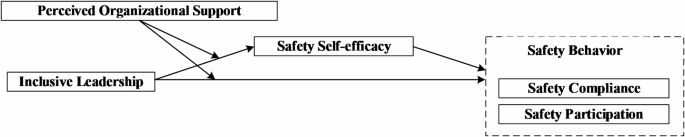
Firstly, inclusive leaders create a work atmosphere that encourages diversity and embraces differences by demonstrating respect, fairness, and openness in their management style12. This leadership style can enhance employees’ self-efficacy15,44, making them more confident in taking safety measures when facing the unique challenges of high-altitude construction. Additionally, inclusive leadership can promote the free flow of information and effective communication among team members45,46, ensuring the transparency and adherence to safety protocols, thereby reducing accident risks. Secondly, perceived organizational support, as the degree to which employees perceive the organization as caring for their personal well-being, is a key factor influencing employee attitudes and behaviors47,48,49. In the harsh conditions of high-altitude construction, employees face both physiological and psychological pressures. At this time, the organization can effectively enhance perceived organizational support by providing safety training, health protection, and psychological counseling, which not only directly improves employees’ safety self-efficacy but also increases their loyalty and commitment to the organization, thereby enhancing their safety behavior. Therefore, perceived organizational support plays a catalytic role in this process. Specifically, based on an inclusive leadership style, higher perceived organizational support will further strengthen construction workers’ trust and dependence on leaders and the organization, thus improving their safety self-efficacy and safety behavior levels. Conversely, if construction workers do not feel supported by the organization or if the organization provides inadequate support and resources, even with the encouragement of inclusive leadership, they may still adopt cautious or negative attitudes towards their safety behavior. For example, insufficient investment in safety by the organization or delayed responses to reasonable demands from construction workers may lead them to perceive a lack of care from the organization. This can result in a reduction in their safety self-efficacy and might lead to non-compliant behavior during construction, reducing their enthusiasm and safety behavior levels, which in turn increases the occurrence of unsafe behaviors. Therefore, this paper proposes the following research hypotheses:
Hypothesis 5
Perceived organizational support positively moderates the relationship between inclusive leadership and safety self-efficacy.
Hypothesis 6a
Perceived organizational support positively moderates the relationship between inclusive leadership and safety compliance among new-generation high-altitude railway construction workers.
Hypothesis 6b
Perceived organizational support positively moderates the relationship between inclusive leadership and safety participation among new-generation high-altitude railway construction workers.
link